Friday 6 March 2026, 08:31 AM

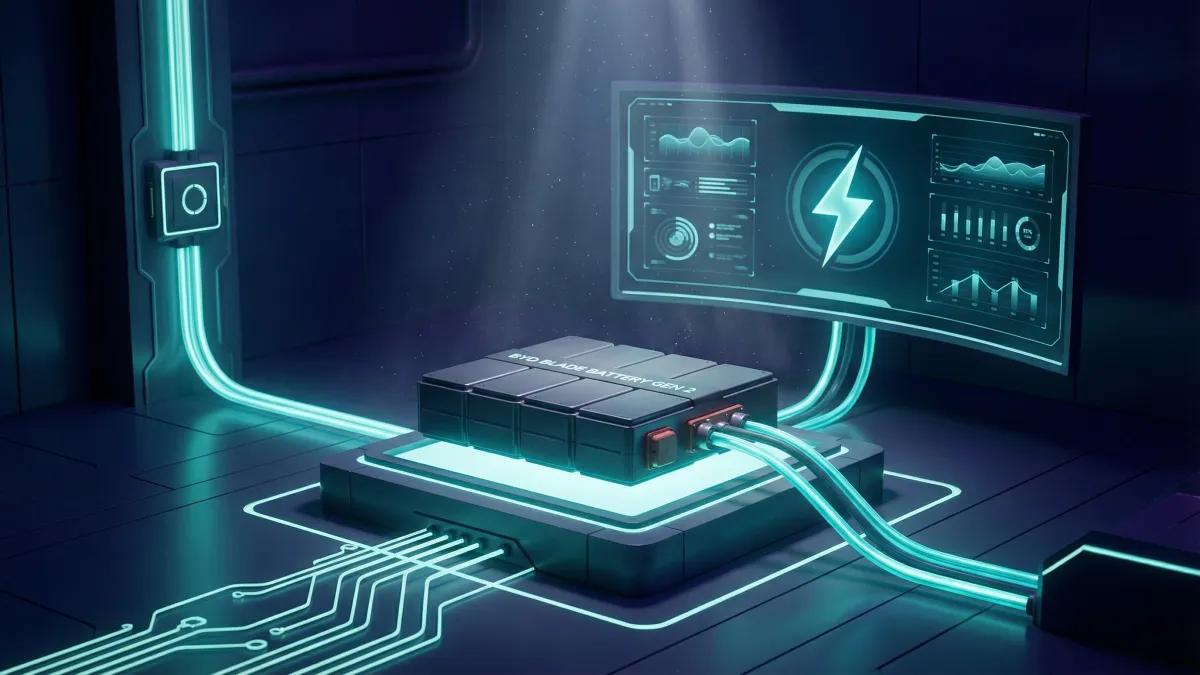
BYD unveils second-generation Blade Battery and flash charging technology
BYD's second-gen Blade Battery achieves record-breaking 5-minute charging and 1,000km range, revolutionizing EV infrastructure and cold-weather performance.
If you've ever driven an EV up to Lake Tahoe in the middle of January, you know the drill. You're constantly doing mental math, watching your range drop faster than the temperature, and hoping the charging station off the highway isn't occupied by five other freezing drivers. Range anxiety is the ultimate user experience hurdle for electric vehicles. But what if we could just... delete it?
BYD just unveiled their second-generation Blade Battery, and honestly, it feels like we are finally crossing the bridge from early-adopter compromises to unquestionable mainstream supremacy. I absolutely love practical innovation that actually ships—no vaporware here—and this is exactly the kind of scalable tech that makes me wildly optimistic about the future of transportation. Let's dream a little bit about what this means for our daily commutes and cross-country road trips.
Saying goodbye to range anxiety with BYD's latest breakthrough
Let's talk about the raw numbers, because they are nothing short of spectacular. The new Blade Battery charges from 10% to 70% in just five minutes. Read that again. Five minutes. That is less time than it takes me to order and wait for a pour-over coffee at my local café.
Five minutes to freedom: the magic of the second-generation Blade Battery
For years, we've talked about how to make the EV charging experience mirror the legacy gas station model. We want the sustainability of electric vehicles without sacrificing the sheer convenience of a quick pit stop. With this new iteration, BYD is turning that pipe dream into a tangible reality. By pushing the boundaries of what their Flash Charging technology can handle, they are effectively solving the biggest friction point in EV adoption.
It's not just about charging fast, either. It's about how far that charge actually takes you. This technology is making its grand debut in the Yangwang U7 sedan, which is packing a massive 150 kWh battery pack. The result? A jaw-dropping 1,006 km range. We are looking at a world where you could drive from San Francisco to San Diego, and still have enough juice to cruise around town for the weekend before even thinking about finding a plug.
Surviving the freeze: making -20°C look like a breeze
If there is one thing that has historically turned EVs into expensive paperweights, it's extreme cold. Battery chemistry is notoriously finicky when the mercury plummets. But BYD's engineers have managed to keep this new battery highly efficient even at -20°C.
This is a massive win for accessibility and global scalability. Electric vehicles shouldn't just be optimized for those of us living in temperate coastal tech hubs. If we want sustainable innovation to truly take over, the tech needs to work flawlessly in the brutal winters of the Midwest, Northern Europe, and beyond. This cold-weather performance proves that we are finally moving past fair-weather EVs and building resilient tech for everyone.
The infrastructure play: 20,000 stations by the end of 2026
Of course, a lightning-fast battery is only as good as the charger you plug it into. I've seen too many brilliant hardware startups fail because they built a great product but ignored the ecosystem required to support it. BYD isn't making that mistake.
Alongside the vehicle and battery announcements, they dropped a massive infrastructure commitment: deploying 20,000 megawatt-level Flash Charging stations across China by the end of 2026. This isn't just a hardware launch; it's a full-stack ecosystem play.
Seeing a company tackle both the product and the infrastructure at this scale is incredibly inspiring. It sets a new benchmark for the rest of the industry. If BYD can successfully roll out a megawatt-level network that supports five-minute charging, it's going to force every other automaker and charging network on the planet to step up their game.
The transition to sustainable energy shouldn't feel like a compromise. It should feel like an upgrade. And looking at what BYD is bringing to the table, the future of driving looks incredibly bright—and incredibly fast.