Thursday 14 May 2026, 04:03 PM

Bypassing the tower: How Halter's P5 collars use Starlink for remote virtual fencing
Discover how Halter's April 2026 P5 smart collars use Starlink satellite connectivity and mesh networking to enable virtual fencing in remote, off-grid farms.
I’ve spent the better part of a decade watching the tech industry try to disrupt agriculture. Usually, the attempts result in hyper-local IoT sensors that fail the moment they lose line-of-sight to a base station, or capital-intensive hardware that only works on perfectly flat, heavily infrastructure-supported land. But what happened late last month feels fundamentally different.
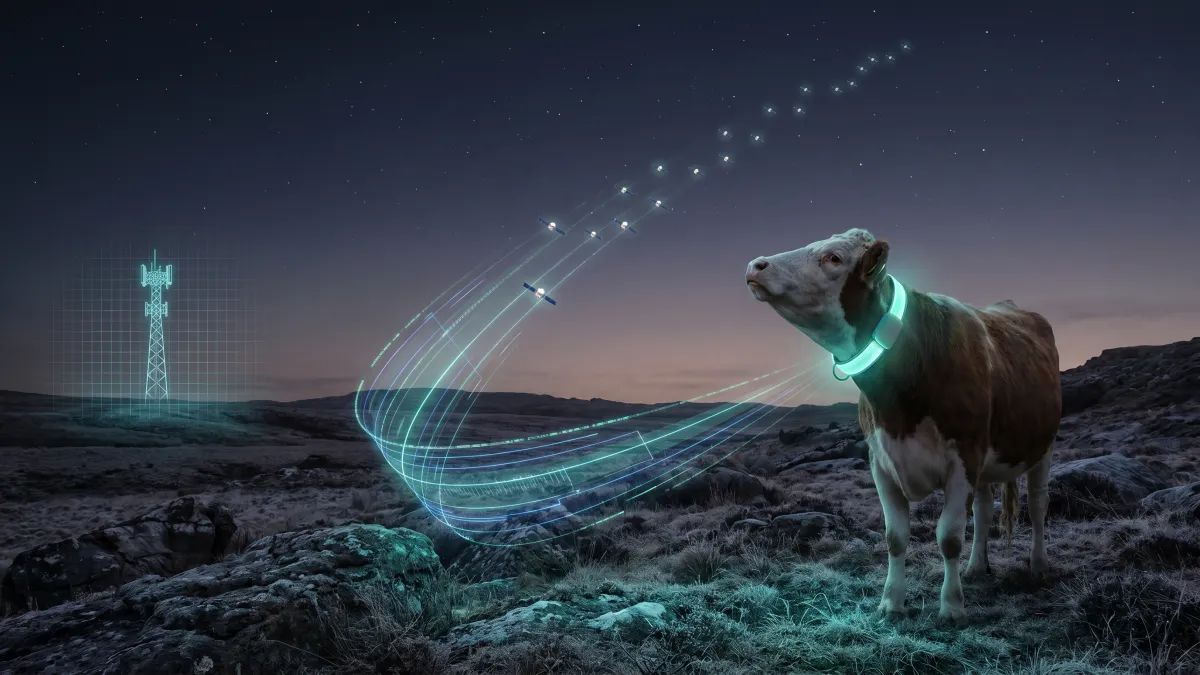
On April 28, 2026, Halter officially launched the P5—the world's first direct-to-satellite virtual fencing system for cattle. By tapping into SpaceX's Starlink network, Halter has completely eliminated the need for ground-based transmission towers. We are looking at a genuine paradigm shift in precision livestock management, moving from localized, fragile radio networks to resilient, global satellite connectivity.
When you remove the physical constraints of ground infrastructure, the entire map opens up.
Mesh networking meets low-earth orbit
The core engineering challenge with agricultural wearables has always been power consumption. You simply cannot have thousands of individual collars maintaining a continuous uplink to a low-earth orbit satellite without draining a solar-powered battery in hours.
Halter’s solution is an elegant piece of architecture. Instead of every collar acting as an isolated uplink, the P5 system utilizes a highly efficient, herd-wide mesh network. The collars communicate locally with one another, and only a single node connects to the Starlink satellite every few minutes. That single connection is enough to download updated virtual boundary coordinates and upload aggregated telemetry data for the entire herd.
This means the cattle are effectively acting as their own decentralized network. The collars then dictate movement and enforce boundaries using a combination of directional audio, vibration, and low-energy electric pulses. From a scalability perspective, this is exactly the kind of hardware-software synergy we look for when evaluating long-term viability. It solves the battery bottleneck while maintaining the data fidelity required for real-time management.
Redrawing the boundaries of agriculture
Looking out over the next five to ten years, the implications of software-defined fencing are massive. The immediate benefit is the mitigation of severe labor shortages and rising input costs—manual mustering and stringing miles of physical wire are quickly becoming relics of the past.
But the secondary effects are where the real transformation happens. At the High Lonesome Ranch in western Colorado, the P5 system is currently deployed across 225,000 acres of complex, rugged terrain. Because the collars track continuous behavioral data, they effectively act as an early warning system for predator attacks, such as wolves. Furthermore, this tech enables precision conservation. If a rancher needs to protect a sensitive ecological zone or a recovering waterway, they can fence it off instantly with a few taps on a screen.
By bypassing the need for proprietary LoRa base towers, Halter dramatically increases its total addressable market. Internal models suggest this direct-to-satellite approach expands their potential US beef cattle market by 2.5 times and increases accessibility for New Zealand beef farms by at least 20 percent. Terrain that was previously unviable for smart agriculture is now fully online.
The hidden costs of a software-defined ranch
Despite the enterprise maturity of the platform—Halter has already sold over 1 million collars and drawn 1.25 million kilometers of virtual fencing globally—we have to look critically at the ecosystem we are building.
Transitioning from physical infrastructure to cloud-based infrastructure introduces new vulnerabilities. Total reliance on Starlink creates a massive single point of failure. If the constellation experiences an outage, or if geopolitical shifts alter satellite availability, what happens to a herd of thousands roaming without physical boundaries?
Furthermore, the removal of physical fences risks severe technological lock-in. Once a rancher transitions entirely to Halter's proprietary ecosystem, switching competitors becomes incredibly frictionless in theory, but practically impossible if the data formats and hardware are siloed.
There is also the regulatory and social friction to consider. While animal welfare groups like the RSPCA have raised valid concerns regarding the use of electric pulse corrections, the legislative momentum is clearly shifting in favor of the technology. In February 2026, following specific legislative amendments to the Prevention of Cruelty to Animals Regulations, the P5 became the first virtual fencing product legally approved for use in Victoria, Australia, backed by the state's Minister for Agriculture.
This regulatory green light in a stringent market like Australia is a massive indicator of where the industry is heading. It positions Halter perfectly for global expansion into massive, untapped markets across South America and Africa.
We are watching the physical boundaries of the world be digitized. If Halter can navigate the risks of ecosystem lock-in and maintain reliable orbital connectivity, the concept of a physical fence might soon seem as outdated as the dial-up modem.
References
- https://www.basenor.com/blogs/news/starlink-powers-world-first-satellite-cattle-collars-by-halter
- https://www.farmersweekly.co.nz/technology/halters-latest-technology-is-out-of-this-world/
- https://www.americanagnetwork.com/2026/05/06/halter-launches-world-first-virtual-fencing-via-satellite-unlocking-ranch-management-anywhere/
- https://www.youtube.com/watch?v=KSYBhL4_rHI
- https://www.westvicbrolga.com.au/p/virtual-fencing-first-product-approved-victoria
- https://www.halterhq.com/articles/virtual-fencing-for-cattle-now-powered-by-satellite
- https://trfm.com.au/articles/virtual-fencing-approved-2/
- https://coloradosun.com/2026/05/13/colorado-ranchers-expanding-footprints-with-virtual-fencing/
- https://www.premier.vic.gov.au/first-virtual-fencing-product-approved-use
- https://www.halterhq.com/en-au/news/halter-launches-world-first-virtual-fencing-via-satellite
- https://agriculture.vic.gov.au/livestock-and-animals/animal-welfare-victoria/pocta-act-1986/electronic-collars/virtual-fencing-for-livestock/using-virtual-fencing-and-herding-for-cattle
- https://www.forbes.com/sites/catzxwang/2025/12/11/smart-collars-for-cows-how-this-31-year-old-entrepreneur-is-transforming-cattle-farming/
- https://pulse.auctionsplus.com.au/people/virtual-fencing-gets-green-light-at-ag-tech-event
- https://www.farmprogress.com/technology/sky-is-the-limit-with-virtual-fencing-literally
- https://newswire.co.nz/2026/04/aucklands-halter-pulls-off-a-world-first-as-cattle-collars-start-talking-directly-to-satellites/