Tuesday 14 April 2026, 02:04 PM

Cybernetic farming: Optimizing biofertilizers with nanopore sequencing and Edge AI
Discover how in-situ nanopore sequencing and edge-based federated learning enable real-time soil microbiome mapping to dynamically optimize biofertilizers.
I spend a lot of time looking at distributed systems and cloud infrastructure, but lately, the most fascinating edge computing deployments aren't happening in server farms—they are happening on actual farms.
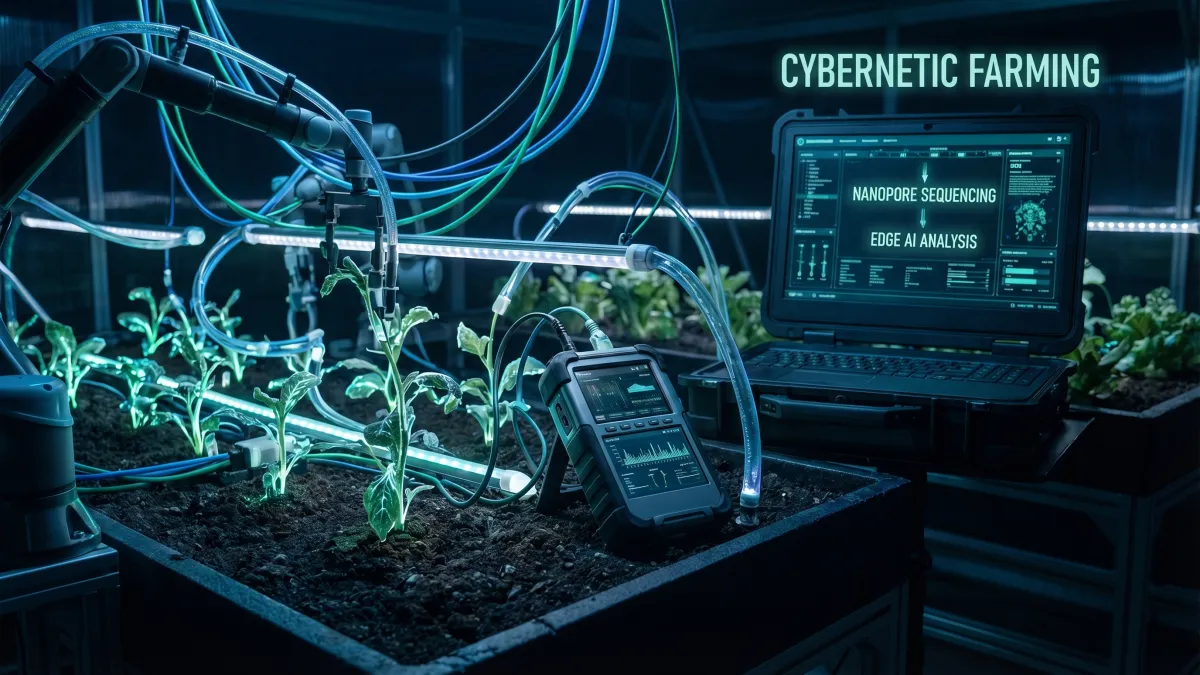
We are currently tracking a massive architectural shift in agricultural technology. The industry is moving away from static, spray-and-pray chemical applications toward what is essentially a closed-loop, real-time API for soil. It is being called "cybernetic nutrient management," and it relies on a fascinating convergence of in-situ nanopore sequencing, edge AI, and federated learning.
If you want to understand where the next massive leap in physical scalability is happening, look at the dirt.
Fixing the biofertilizer bottleneck at the edge
For the last few years, nitrogen-fixing biofertilizers have been hailed as the silver bullet for agricultural runoff and synthetic fertilizer reliance. Companies like Pivot Bio are already deploying engineered microbes, such as their PROVEN 40 line, across millions of acres of US corn. Kula Bio recently pulled in over $72 million in venture capital to advance microbes that store their own energy to fix nitrogen longer.
But there is a glaring implementation problem: unpredictable field performance.
When you introduce engineered microbes into soil, they have to compete with the native microbiome. If you apply them in an unoptimized zone, they die off or underperform. Until now, the feedback loop required taking physical soil samples, shipping them to a lab, and waiting weeks for metagenomic analysis. By the time the data comes back, the soil dynamics have completely changed. It is like trying to optimize a live web application using server logs from last month.
The hardware stack: from mud to inference
To close this loop, the processing has to move to the edge. The current advanced pilot systems (sitting around TRL 4-5) are doing exactly this by combining Oxford Nanopore Technologies (ONT) MinION sequencers with heavy local compute.
The MinION sequencers run directly in the field, analyzing full-length 16S rRNA and functional genes like nifH to map microbial dynamics in real time. But raw genomic sequencing generates a massive payload of data. If you have ever tried to push gigabytes of raw data over a rural 3G connection, you know it is a non-starter. You simply cannot rely on the cloud when your edge node is in the middle of a cornfield in Iowa.
This is where the compute layer steps in. Recent 2026 benchmarks have proven that NVIDIA Jetson AGX Orin modules can handle this bioinformatics pipeline locally. We are seeing these edge modules ingest IoT sensor data and soil DNA sequencing to deliver sub-50ms inference latency. Even better, they can sustain 7-day offline operations.
The software layer caught up late last year with the late-2025 release of MMonitor. Because it is open-source and specifically designed to process ONT sequencing data in real time, it bypasses the need for a dedicated bioinformatics team. It automates the processing of metagenome reads on-site, effectively turning a tractor or a field station into a self-sufficient data center.
Federated learning as the privacy shield
From a systems architecture perspective, the most elegant part of this deployment is how it handles data privacy.
Farmers are notoriously—and rightfully—protective of their yield and soil data. Asking them to upload their proprietary farm data to a centralized cloud to train a global AI model is a massive friction point.
By utilizing federated learning, the NVIDIA edge modules train their models locally. They learn the specific microbial dynamics of that exact farm and then only transmit the model weight updates back to the central server. The global model gets smarter, but the raw, proprietary data never leaves the local hardware. This guarantees data sovereignty while still allowing the system to dictate the variable-rate application of microbes, preventing waste in highly active microbial zones and boosting application in dead zones.
This specific architecture—federated learning combined with multi-omics—is exactly what the European Union is betting on. Their HORIZON-CL6-2026-02-FARM2FORK-11 initiative just closed on April 14, 2026, dropping €11.00 million into research and innovation actions to build out these exact systems.
Market consolidation and Microbiome-as-a-Service
Whenever a complex hardware-software integration starts showing real commercial viability, market consolidation follows. The commercial soil microbiome sector is capitalizing rapidly.
We just saw EarthOptics and Pattern Ag merge to create high-resolution digital twins of soil. Trace Genomics recently secured a $10.5 million Series B to expand their DNA-based soil health analysis. The business model is clearly shifting from selling jugs of synthetic fertilizer to a "Microbiome-as-a-Service" model. You aren't just buying nutrients; you are buying a dynamic, automated system that reads the soil's genome and deploys biological payloads exactly where and when they are needed.
Where the architecture breaks down
As optimistic as I am about this stack, deploying high-performance computing in the mud comes with severe operational risks.
First, there is the hardware degradation. Silicon, delicate nanopore flow cells, and harsh agricultural environments are natural enemies. Maintaining uptime on edge modules exposed to extreme heat, moisture, and vibration is going to be a massive headache for hardware engineers.
Second, there is a biological risk. When you use AI to hyper-optimize specific taxa—like nitrogen-fixing bacteria—you run the risk of creating unforeseen ecological imbalances in the soil ecosystem. We are treating the soil like a predictable state machine, but it is a highly complex, living ecosystem.
Finally, the digital divide is going to widen. The capital expenditure required to outfit a farm with Jetson edge modules, nanopore sequencers, and variable-rate application hardware is steep. While the technology promises to drastically reduce synthetic fertilizer costs and eliminate nitrogen runoff over the next 3 to 5 years, it will likely be the massive, well-capitalized agricultural operations that benefit first.
Still, the integration of these technologies is a masterclass in solving physical bottlenecks with edge compute. We are finally giving the earth a nervous system, and the underlying architecture is brilliant.
References
- https://iksadyayinevi.com/wp-content/uploads/2025/11/CYBERNETIC-NUTRIENT-MANAGEMENT-CLOSED-LOOP-SYSTEMS-INTEGRATING-PLANT-ELECTROPHYSIOLOGY-AND-MICROBIAL-COMMUNITIES-1.pdf
- https://www.frontiersin.org/journals/microbiology/articles/10.3389/fmicb.2026.1770580/full
- https://www.frontiersin.org/journals/soil-science/articles/10.3389/fsoil.2025.1706999/full
- https://apsjournals.apsnet.org/doi/10.1094/PBIOMES-05-20-0042-RVW
- https://ijsrem.com/download/advanced-smart-agriculture-system-using-edge-ai-iot-deep-learningand-blockchain/
- https://www.researchgate.net/publication/401696035_Advanced_Smart_Agriculture_System_Using_Edge_AI_IOT_Deep_Learningand_Blockchain
- https://vertexaisearch.cloud.google.com/grounding-api-redirect/AUZIYQH1W0VhnhNpkXLG_8SquoW1ywds90SrydoxascSwriiJ_ntD0MqtFkgz253S78p9VokEtDOypuMuLS0AZq0iX4dk65ro6Hq4Xc1wDo6mmAjRap-pfyEKj0faR2GP1C4Ira6IV01VYBFXIfuYiACJfunypFERU6nfFfBuN9hkF_c9XqzFlRHWkTaAe3GtxrBg9Rclq5NmQ==
- https://ijariie.com/AdminUploadPdf/AI_Based_Soil_Health_Monitoring_Using_Remote_Sensing_and_Deep_Learning_ijariie26395.pdf
- https://www.businessinsider.com/trace-genomics-uses-dna-sequencing-to-stop-soil-erosion-2023-5
- https://pmc.ncbi.nlm.nih.gov/articles/PMC12930504/
- https://www.wusf.org/environment/2023-06-11/the-price-of-plenty-technology-help-find-better-fertilizer
- https://www.etcgroup.org/files/files/02_fertilizer.pdf
- https://accelopment.com/blog/funding/microbiome-food-systems-innovation-horizon-europe/
- https://vertexaisearch.cloud.google.com/grounding-api-redirect/AUZIYQGQntVl2svuZJmKdMWFFyU6C0gkiQ5PplbEIp4QdugNb2bvW6H0sIJGfT7cvbwQpsbngNr5qLEsv-3aPMBuUqcbLGjWLv83sN9Czikri8Vy8xPd2IA5b57YkX_LG1p6UKqF2uCvzIsmPtfveXQ-T4EtklKIZWtsHSYlOqLqzm9qA1y_M522TIKFpIXsPbawbFPnHw4RlV_Ncu3lV7bRp81kyy6c0VYKAvQR5mvopduxsQEAuOePUFoRfEZTdkDv
- https://pmc.ncbi.nlm.nih.gov/articles/PMC12853177/
- https://igrownews.com/2024-agtech-year-in-review-key-developments/
- https://www.agweb.com/news/biodiversity-index-field-look-diagnostic-microbiome-tests-soil-health
- https://www.forbes.com/councils/forbestechcouncil/2023/04/24/are-microbes-the-future-of-fertilizer/
- https://training-portal.nifa.usda.gov/web/crisprojectpages/1024178.html
- https://cleantech.com/crop-inputs-hold-the-key-to-climate-resilient-food-production-in-a-warming-more-populous-world/
- https://pmc.ncbi.nlm.nih.gov/articles/PMC12962961/
- https://www.biorxiv.org/content/10.1101/2025.09.20.676612v1.full
- https://ijsra.net/sites/default/files/fulltext_pdf/IJSRA-2022-0267.pdf