Tuesday 10 November 2026, 09:05 PM
The dawn of the quantum data center: Oxford's breakthrough in distributed quantum error correction
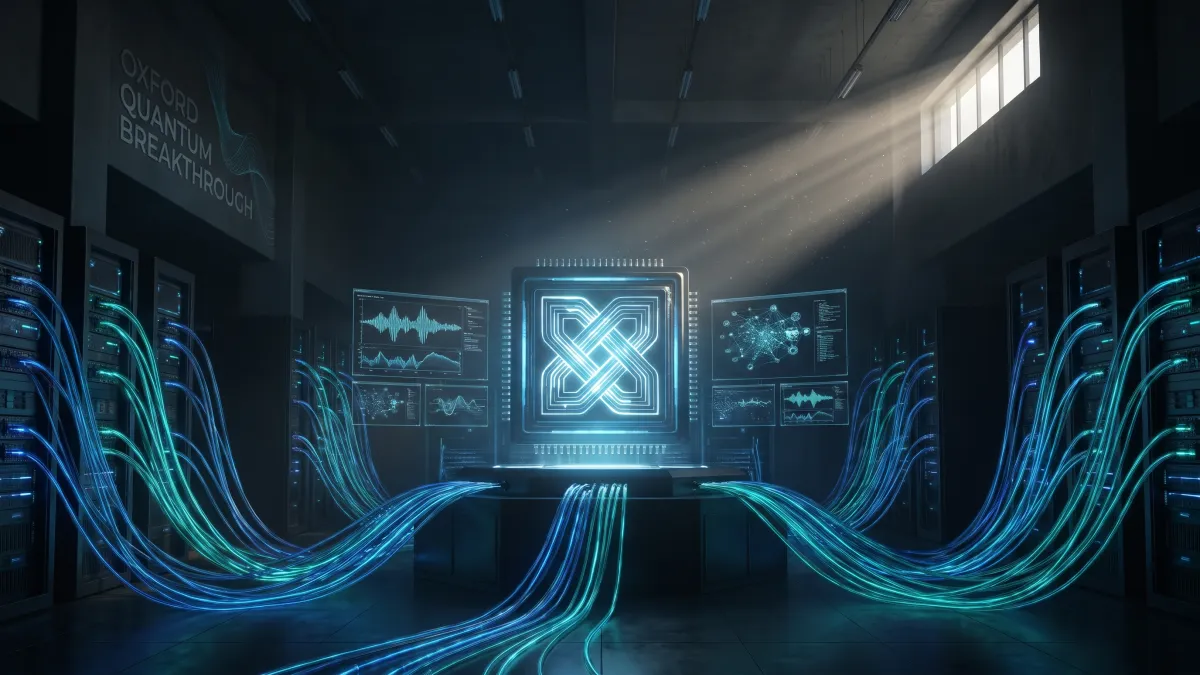
Oxford's Sept 2026 breakthrough in distributed quantum error correction uses trapped ions and real-time feedforward to enable modular quantum data centers.
I have spent the last decade working in enterprise IT across the Bay Area, and if there is one constant, it is that cramming more compute into a single box eventually hits a wall. We saw it when the industry migrated from monolithic mainframes to distributed data centers. Right now, I am watching quantum computing make that exact same transition.
For years, the focus was on packing more qubits onto single chips, which inevitably led to nearest-neighbor connectivity limits, cooling constraints, and crosstalk. But a September 2026 preprint from Oxford University caught my eye because it outlines the mechanics of a modular quantum data center. It feels like history repeating itself.
Two meters of fiber and a repetition code
The Oxford team managed active correction of arbitrary single-qubit Pauli errors across two physically separate trapped-ion processors sitting two meters apart. They used a dual-isotope setup: Strontium-88 ions generated entanglement over an optical fiber link, which was then mapped onto Calcium-43 data qubits.
By utilizing mid-circuit remote syndrome measurements and real-time classical feedforward, they executed a distributed [[2, 1, 1]] repetition code without collapsing the encoded state. From an infrastructure perspective, this proves we can link independent processors over a network to maintain a shared quantum state, bypassing the physical limits of a single chip.
The networking engineers are taking over
We already know trapped-ion hardware provides the necessary baseline stability. Just last month, in October 2026, Quantinuum hit a 99.9995% logical fidelity on its Helios 98-qubit trapped-ion processor. That is just five errors per million operations—about 100 times lower than current superconducting systems. Before that, in June, IonQ achieved breakeven quantum error correction using quantum low-density parity-check (qLDPC) codes on a 40-ion chain of Barium-133.
This dictates where the industry is heading over the next decade. qLDPC codes require fewer physical qubits to protect a logical qubit, but they demand long-range stabilizer measurements. Standard 2D grids cannot route these efficiently. The Oxford demonstration solves this routing problem by proving we can perform these measurements across entirely different processors. Because of this, the founders building the most valuable quantum companies over the next ten years might not be quantum physicists. They are going to be classical network engineers who know how to route data.
Beating the decoherence clock
The physics problem of quantum scaling is rapidly becoming a classical networking problem. To make distributed quantum error correction work, the classical feedforward loop has to outpace the quantum decoherence times of the qubits. If the classical network lags by a fraction of a millisecond, the qubits sit idle, accumulate errors, and the system fails.
This shifts the immediate engineering bottleneck to ultra-low-latency networking and FPGA development. We need classical infrastructure that can keep up with quantum states. Hardware startups are already adapting to this requirement. Nu Quantum recently opened Europe's first dedicated industrial R&D facility in Cambridge to test and integrate photonic networking hardware, like optical microcavities, with trapped-ion systems.
The unglamorous work ahead
Operating a distributed quantum supercomputer also requires a software stack that can partition complex qLDPC codes across multiple processors. Developers are starting to build these tools. In September 2026, new open-source AI tools and Claude Skills, like the 'Distributed Quantum Error Correction' package, dropped to help engineers analyze the inter-processor entanglement overhead required for fault-tolerant operations.
When I look at where this industry is heading, the focus is moving away from isolated lab records and toward systems integration. Building a functional quantum data center means laying miles of optical fiber, optimizing FPGAs to shave nanoseconds off feedforward loops, and writing the orchestration software to manage it all. We are moving past theoretical physics and entering a long phase of hard, practical IT engineering. The real work now is grinding out the classical networks required to tie these qubits together.
References
- https://arxiv.org/abs/2609.13065
- https://arxiv.org/pdf/2609.13065
- https://thegoodsignal.com/en/posts/oxford-distributed-quantum-error-correction-ions-2026
- https://arxiv.org/html/2609.13065v2
- https://www.physics.ox.ac.uk/our-people/ayushagrawal/publications
- https://www.researchgate.net/publication/414277336_Error_Correction_in_a_Distributed_Quantum_Computer
- https://newsletter.thecompute100.com/p/sept15-2026
- https://error-correction-lab.github.io/QCEWorkshop2026/
- https://aqora.io/papers/2609.13065
- https://ir.quantinuum.com/news-releases/news-release-details/quantinuum-breaks-error-correction-world-record-10x-validating
- https://www.reddit.com/r/QuantumComputing/comments/1xah0mz/quantinuum_breaks_errorcorrection_world_record_by/
- https://postquantum.com/quantum-research/ionq-qldpc-breakeven-trapped-ion/
- https://qwcbrand.com/news/when-more-qubits-arent-enough-nu-quantum-network-computers
- https://www.skillsdirectory.com/skills/hiyenwong-distributed-quantum-error-correction
- https://thequantuminsider.com/2026/09/19/tom-darras-welinq-scaling-quantum-computers-by-networking-shared-entanglement/
- https://qce.quantum.ieee.org/2026/qce26-schedule/qnet-schedule/
- https://www.quantum-machines.co/press-release/quantum-computings-next-leap-may-be-classical-leading-researchers-suggest/
- https://www.researchgate.net/figure/Distributed-rotated-surface-code-definition-Filled-dots-represent-data-qubits-and-empty_fig2_401114496