Thursday 26 March 2026, 07:03 PM

Engineering high-energy barley with CRISPR to cut livestock methane emissions
Rothamsted Research used CRISPR to create high-lipid barley, a Precision Bred Organism that boosts livestock feed efficiency and cuts ruminant methane by 20%.
Living in the Bay Area, it is easy to get tunnel vision when we talk about climate tech. We obsess over direct air capture, grid-scale battery storage, and the latest EV architectures. But if we want to talk about massive, unoptimized systems with outsized environmental footprints, we have to look at global agriculture—specifically, livestock.
Ruminant methane emissions are essentially a massive, legacy bug in our food supply chain. For years, the proposed solutions have felt like workarounds: changing grazing patterns, adding complex feed supplements, or simply telling people to eat less meat. But what if we could patch the problem at the source code level of the feed itself?
That is exactly what is happening right now in the UK. On March 25, 2026, researchers at Rothamsted Research hit a massive milestone. Their CRISPR-edited, high-lipid barley became the first crop to receive a Precision Bred Organism (PBO) marketing notice confirmation under England's newly established regulatory pathway. It is a textbook example of practical, scalable innovation that could shift the paradigm of how we manage agricultural emissions over the next decade.
Patching the methane bug at the source
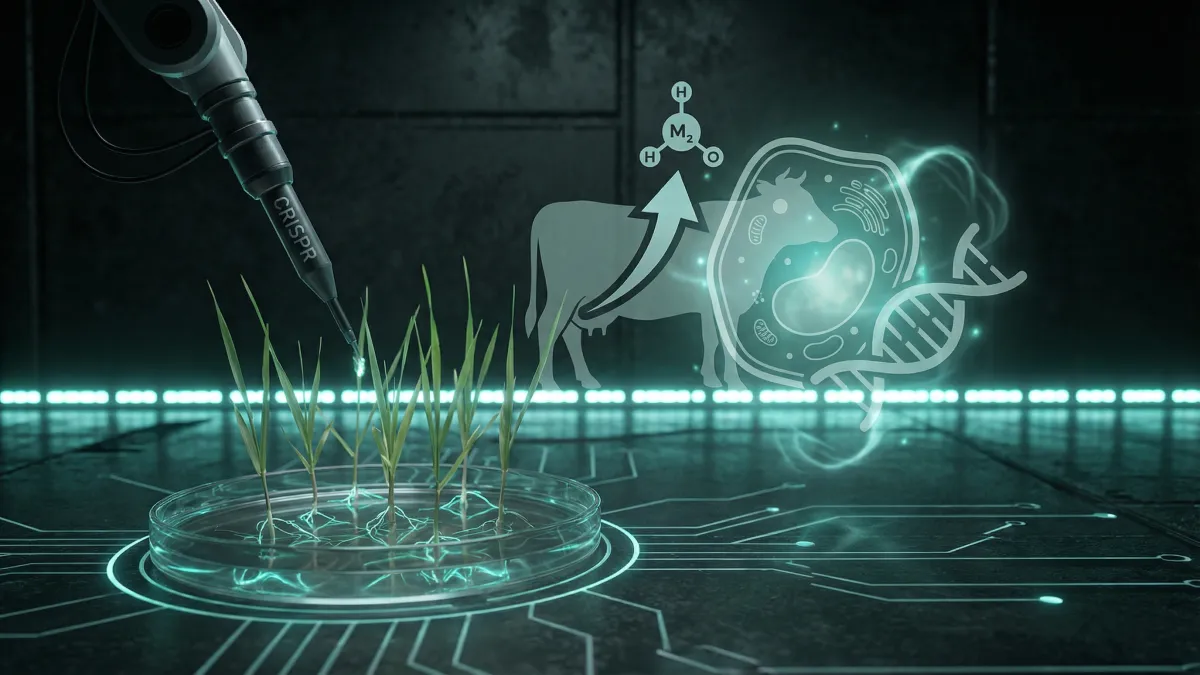
The science behind this is elegant. The Rothamsted team used CRISPR/Cas9 gene editing on a barley cultivar known as 'Golden Promise'. Instead of splicing in foreign DNA—which triggers the heavy-handed, legacy GMO regulations we see in much of the world—they simply knocked out specific lipase genes. This targeted deletion suppresses the plant's natural lipid breakdown pathways, effectively doubling the lipid content in the vegetative tissues to about 4%.
From a systems perspective, this does two things simultaneously. First, it optimizes the "user experience" for the farmer. The higher metabolic energy of the forage accelerates livestock fattening and improves both meat and milk yields. It makes economic sense.
But the real breakthrough is what happens inside the cow. This specific lipid profile actively alters the bovine rumen microbiome. It suppresses the population of methanogenic archaea, directly reducing the methane output of a single cow by 15% to 20%. We are not just making feed more efficient; we are using the crop itself to reprogram the gut flora of the livestock eating it.
Escaping the regulatory sandbox
In tech, we know that a great prototype means nothing if the regulatory environment prevents you from shipping it. The advancement of this gene-edited barley was entirely unlocked by the UK's Genetic Technology (Precision Breeding) Regulations 2025, signed into law by Defra.
This legislation is a massive deal because it creates a distinct legal framework that differentiates targeted gene edits from traditional GMOs. It is the regulatory green light that allows these crops to finally exit the laboratory.
Currently, this high-energy barley is the flagship crop in the PROBITY (Platform to Rate Organisms Bred for Improved Traits and Yield) project. Coordinated by the British on-Farm Innovation Network (BOFIN), this initiative marks the first farmer-led trials of gene-edited crops on conventional, commercial farms in the UK and Europe. It is the agricultural equivalent of a public beta test. They are bridging the critical gap between academic theory and real-world deployment, ensuring the crop actually integrates into existing farming workflows.
Looking at the 5-to-10-year horizon
If we zoom out and look at the next decade, the 'Golden Promise' barley is just version 1.0. The Rothamsted researchers are already treating it as a highly amenable stepping stone. The ultimate roadmap involves translating these exact dual-gene CRISPR edits into ryegrass. The goal is to engineer calorie-dense pastures with up to 7% lipid dry weight that livestock can graze on directly. If they can pull that off, the scalability of this methane-reduction strategy becomes exponential. You wouldn't even need to harvest and process the feed; the cows would just graze on the solution.
Of course, scaling hardware—or in this case, biology—is never without friction. While the scientific and regulatory maturity in England is high right now, commercialization is still in the pilot stage. The team has to scale seed multiplication and stress-test the crop's agronomic resilience against changing environmental conditions.
More importantly, they face significant geopolitical hurdles. Stakeholders have to navigate internal UK regulatory fragmentation, not to mention the highly restrictive EU GMO laws right next door. These borders could pose serious trade barriers, reminding us that even the most elegant scientific solutions eventually have to survive the complexities of global trade politics.
Still, the authorization of this PBO is a watershed moment. It proves that we can use precision biotechnology not just to increase yield, but to actively re-engineer our ecosystem for the better. It is exactly the kind of quiet, foundational shift that will define the next era of climate tech.
References
- https://www.rothamsted.ac.uk/news/rothamsted-gene-edited-barley-crop-becomes-first-receive-uk-precision-bred-organism-marketing
- https://www.seedquest.com/news.php?type=news&id_article=168406&id_region=&id_category=&id_crop=
- https://www.rothamsted.ac.uk/news/precision-breeding-regulations-signed-law-uk-government
- https://www.rothamsted.ac.uk/news/scientists-looking-forward-first-farmer-led-trials-gene-edited-crops-europe
- https://bofin.org.uk/2024/08/19/probity-launch/
- https://www.fwi.co.uk/machinery/technology/how-precision-breeding-act-is-helping-progress-gene-edited-crops
- https://science.slashdot.org/story/26/03/21/2036248/juicier-steaks-soon-the-uk-approves-testing-of-gene-edited-cow-feed
- https://www.chemistryworld.com/news/gene-edited-crops-set-to-arrive-in-england-but-eu-remains-divided-on-them/4021687.article
- https://www.seedworld.com/europe/2024/08/21/scientists-looking-forward-to-first-farmer-led-trials-of-gene-edited-crops-in-europe/