Wednesday 4 March 2026, 08:11 AM

Google Quantum AI achieves verifiable quantum advantage with Quantum Echoes algorithm
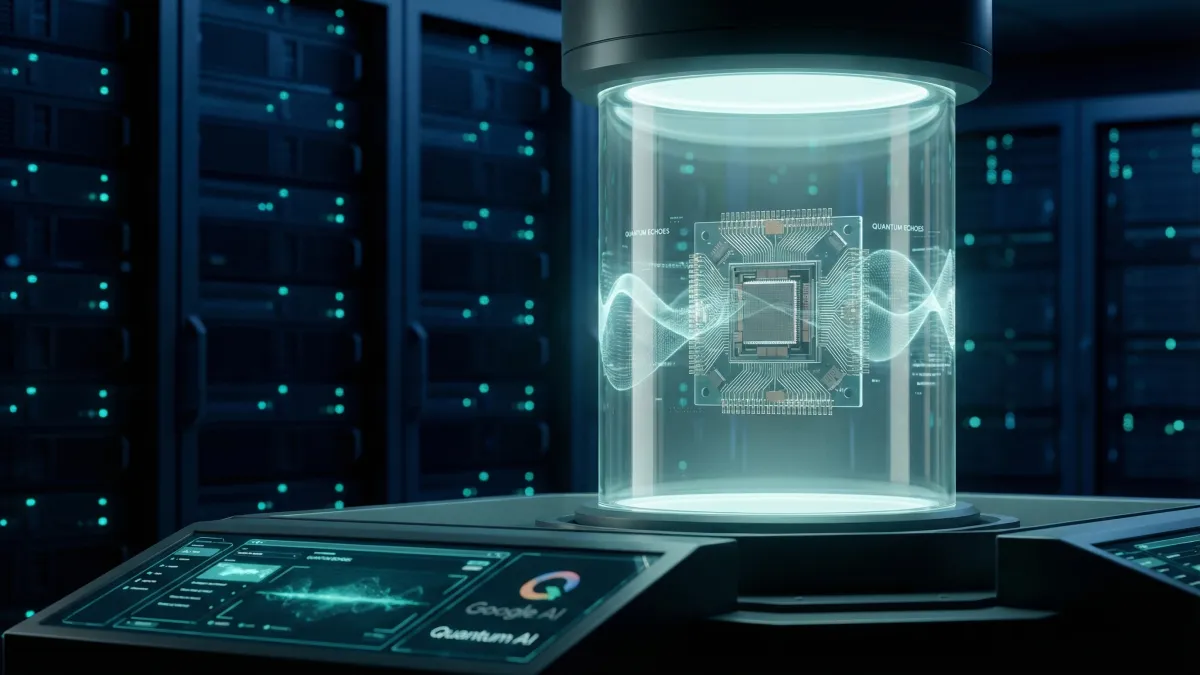
Google Quantum AI achieved verifiable quantum advantage using the Quantum Echoes algorithm on its 105-qubit Willow processor, outpacing supercomputers by 13,000x.
The reality of verifiable quantum advantage
We see a lot of vaporware in the Valley. Every week, a new press release promises to fundamentally change how we interact with machines, but when you look under the hood, the scalability is nonexistent and the actual innovation is marginal. But on October 22, 2025, Google Quantum AI dropped something that genuinely shifts the landscape: the Quantum Echoes algorithm.
Running on their new 105-qubit Willow processor, this isn't just another theoretical whitepaper filled with promises of what might happen in a decade. They've achieved what the industry calls verifiable quantum advantage. In plain terms, they executed a benchmark that performed approximately 13,000 times faster than the absolute top-tier supercomputers we currently rely on.
Translating 13,000x speed into human-centric design
When we talk about quantum computing, the conversation almost always gets bogged down in subatomic physics and cryogenic cooling. But let's look at this through the lens of end-user experience and accessibility.
Classical computing, for all its marvels, has a hard limit. When we try to model complex, real-world problems—like optimizing global supply chains, simulating molecular structures for rapid drug discovery, or building hyper-accurate climate models—we hit a computational wall. Researchers and developers end up waiting months for supercomputers to spit out results. That is a terrible user experience. It stifles iteration. It makes solving world-changing problems deeply unintuitive and inaccessible to all but a few massive institutions.
By using rigorous quantum benchmarking to prove this 13,000x speedup, Google Quantum AI is essentially showing us a future where these massive bottlenecks disappear. Imagine a development environment where engineers can iterate on complex global problems as intuitively and rapidly as we currently compile a mobile app. That is the true promise of the Willow processor. It takes the esoteric and makes it, eventually, practically accessible.
Why Quantum Echoes is a win for tech for good
What makes the Quantum Echoes algorithm stand out to me is the word verifiable. We aren't just taking a lab's word for it; the advantage is mathematically proven and measurable. This matters because if we are going to build scalable, impactful solutions for real people, we need technological foundations we can actually trust.
We are obviously still a few steps away from having quantum processors sitting in our local server racks. But the leap from theoretical math to a verifiable, benchmarked reality means the timeline for "tech for good" just accelerated dramatically. It means the tools we will eventually use to build the next generation of intuitive, life-saving software now have an engine powerful enough to drive them.
For those of us building in this ecosystem, the message is clear: the hardware is finally catching up to our most ambitious, world-positive ideas. Now it's on us to figure out how to design the interfaces and experiences that will harness it for everyone.