Monday 30 March 2026, 12:03 AM

How CSIC and Delft solved the Majorana readout bottleneck in topological quantum computing
CSIC and Delft University achieved single-shot parity readout of Majorana zero modes using quantum capacitance, a major leap for topological quantum computing.
The paradox of the perfect safe box
When I look at the quantum computing landscape, I’m always searching for the bridge between abstract physics and the actual developer ecosystem. We talk endlessly about qubit counts and quantum supremacy, but the reality is that early quantum hardware is incredibly fragile. For the end user—eventually, the developers and enterprises trying to run programs on these machines—fragility means unpredictability. And unpredictability is the enemy of a good user experience.
For over a decade, the industry has been chasing a more elegant solution: topological quantum computing. Instead of fighting environmental noise, this approach uses Majorana zero modes (MZMs) to encode information non-locally. Think of it as a perfectly engineered safe box. Because the data is distributed across a pair of particles, local interference can't corrupt it.
But this inherent protection created a massive usability bottleneck. The safe box was so good at hiding its contents from the outside world that traditional local charge sensors couldn't read the data. If a system is so secure that even the user can't access the output, it’s not a computer; it’s a paperweight.
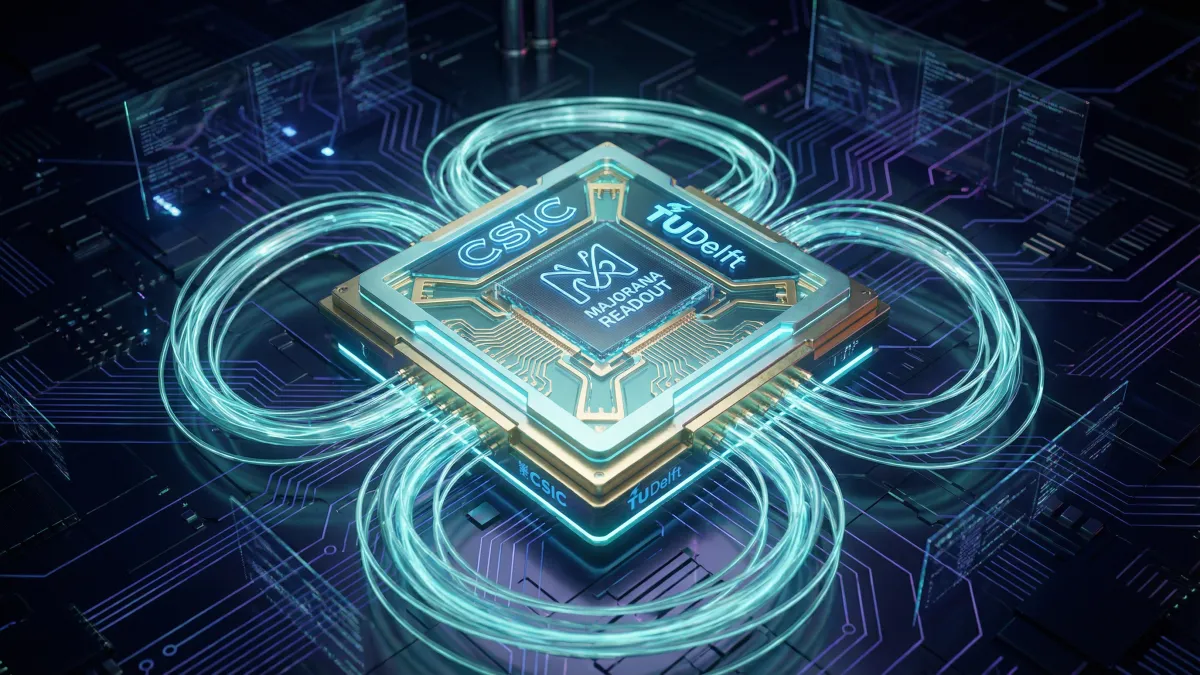
On February 11, 2026, researchers from CSIC and Delft University published a landmark paper in Nature that officially solves this readout problem. They achieved the first successful single-shot parity readout of a minimal Kitaev chain, effectively figuring out how to open the safe box without destroying the delicate quantum state inside.
Reading the unreadable qubit
To pull this off, the CSIC and Delft teams had to rethink how we interface with quantum materials. They built a highly specific, bottom-up nanostructure using semiconductor quantum dots—specifically indium arsenide—coupled with an aluminum superconductor. By manipulating these materials at the atomic level, they forced the emergence of Majorana particles in a deterministic, modular way, bypassing the unpredictability we usually see in bulk materials.
The breakthrough in accessibility came down to how they measured the system. The researchers ran local charge sensing alongside a global quantum capacitance probe connected to an RF resonator. The results were exactly what you want to see for fault-tolerant computing. The local sensors registered absolutely nothing, confirming the states are charge-neutral and protected from local noise. But the global probe successfully resolved the parity—discriminating between even and odd fermionic states in real-time.
They read the unreadable qubit. This moves Majorana qubits from theoretical physics curiosities straight into the realm of measurable, operational hardware components.
Stability means usability
What really caught my attention in the data was the stability benchmark. During the experiment, the team extracted a parity coherence time exceeding one millisecond by observing random parity jumps, known as telegraph switching.
In the quantum hardware space, a millisecond is an eternity. This extended stability duration proves that the quantum states remain intact long enough to eventually execute complex logic gate operations and time-domain control. From a practical standpoint, this is the foundation of intuitiveness in quantum programming. Developers need stable, predictable time-domain control to write algorithms that actually solve real-world problems. Without that millisecond of coherence, we are just flipping coins in the dark.
The geopolitical push and the reality check
It’s impossible to ignore the broader context here. This research was heavily backed by the European Union, specifically through a nearly 5 million euro grant from the European Innovation Council's Pathfinder program under the QuKit project. There is a clear, strategic geopolitical push to develop fault-tolerant quantum computing architectures within Europe, and this funding highlights how critical scalable quantum infrastructure has become.
But we have to remain cautious and look at the actual roadmap. The current Technology Readiness Level (TRL) sits around 3 to 4. We are still dealing with a minimal two-site chain—often referred to as the "poor man's Majorana"—and scaling this up modularly will be incredibly difficult. The engineering teams also have to figure out how to manage microwave dissipation at cryogenic temperatures as these systems grow.
Despite the scaling challenges, this peer-reviewed milestone is a watershed moment. It validates the foundational physics required for the fault-tolerant Topological Core architectures that giants like Microsoft have been aggressively pursuing. We are definitively shifting the industry focus from trying to prove that these particles exist to actually achieving active control and executing logic gates. For those of us waiting for quantum computing to become a practical, accessible tool, this is exactly the kind of progress we need.
References
- https://pubmed.ncbi.nlm.nih.gov/41673287/
- https://www.icmm.csic.es/en/noticias/new-crucial-advance-quantum-computers-researchers-manage-read-information-stored-majorana
- https://quantumcomputingreport.com/single-shot-parity-readout-of-a-minimal-kitaev-chain-a-breakthrough-in-majorana-qubits/
- https://spacedaily.com/quantum-team-reads-information-from-robust-majorana-qubits-using-quantum-capacitance-999/
- https://www.sciencedaily.com/releases/2026/02/260216084525.htm
- https://arxiv.org/html/2507.01606v1
- https://www.techmonitor.ai/hardware/quantum/microsoft-majorana-1-quantum-chip-topological-core-architecture
- https://news.microsoft.com/source/features/innovation/microsofts-majorana-1-chip-carves-new-path-for-quantum-computing/
- https://scitechdaily.com/a-new-way-to-read-the-unreadable-qubit-could-transform-quantum-technology/
- https://physicsworld.com/a/read-out-of-majorana-qubits-reveals-their-hidden-nature/
- https://www.oezratty.net/wordpress/2025/inside-microsoft-majorana-1/
- https://www.usaii.org/ai-insights/microsoft-majorana-1-chip-all-you-need-to-know-guide