Saturday 23 May 2026, 02:03 PM
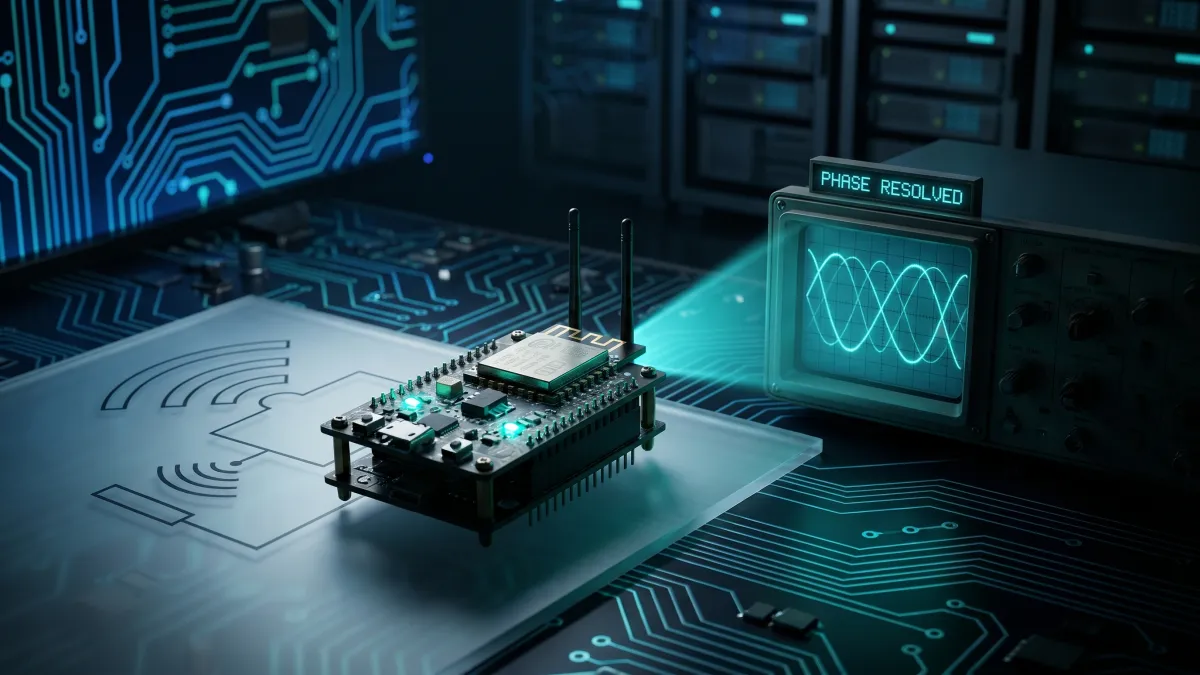
How early 2026 IoT microcontrollers solve Bluetooth 6.0 phase ambiguity
Discover how 2026 IoT MCUs like NXP's MCX W72 use Localization Compute Engines to resolve Bluetooth 6.0 phase ambiguity for secure, precise edge ranging.
The math problem nobody wanted to talk about
If you’ve been tracking the spatial awareness space over the last year, you’ve likely seen the endless hype surrounding the Bluetooth 6.0 Core Specification. The promise is undeniably attractive: replacing the easily spoofed, notoriously flaky RSSI proximity metrics with Channel Sounding (CS) for secure, centimeter-level accuracy. It’s supposed to be the technology that finally democratizes precise ranging.
But when you actually start looking at the implementation layer, the reality is far more complicated.
Bluetooth 6.0 relies on a combination of Round-Trip Time (RTT) and Phase-Based Ranging (PBR). The catch? PBR introduces a massive mathematical hurdle known as phase ambiguity. RF phase measurements reset every 360 degrees. To figure out the true Line-of-Sight path in a complex, multipath environment—like a warehouse full of metal racks or a dense parking garage—you have to run heavy spectral estimation algorithms, such as MUSIC or ESPRIT.
Here is where the Bluetooth SIG left hardware engineers out to dry: they standardized the data collection, but not the distance calculation algorithms. Running complex Eigenvalue Decompositions on a standard edge device essentially crushes the main core. It eats up compute cycles, spikes power consumption, and destroys battery life.
Throwing hardware at a software problem
Instead of waiting for a software miracle, we are seeing early 2026 silicon brute-force the issue with dedicated hardware. The NXP MCX W72 is the poster child for this approach.
Rather than trying to optimize the math for a standard microcontroller, NXP built a highly isolated tri-core architecture. You have your standard Cortex-M33 for the application layer, a dedicated Narrow Band Unit (NBU) for the radio, and a proprietary Localization Compute Engine (LCE).
This LCE is essentially a 64-bit SIMD DSP coprocessor bolted onto the chip for the sole purpose of offloading linear algebra—specifically Fast Fourier Transforms and those dreaded Eigenvalue Decompositions. According to the specs, this hardware acceleration cuts ranging latency by up to 45% and keeps active power consumption low enough for battery-operated IoT nodes.
It’s an impressive feat of engineering. But it begs the question: are we over-engineering Bluetooth just to avoid paying for Ultra-Wideband (UWB)?
Who actually needs this?
When I look at the MCX W72, I have to ask who the target audience really is. UWB already solves the secure, high-precision ranging problem, and it does so without the extreme multipath vulnerabilities of Bluetooth.
The answer, as always in Silicon Valley, comes down to BOM costs.
NXP is actively positioning this tech to cannibalize UWB design wins in mid-tier automotive access and industrial asset tracking. Because Bluetooth LE is already ubiquitous, integrating Channel Sounding allows OEMs to ditch the secondary UWB chip entirely. Furthermore, Bluetooth 6.0 CS utilizes 72 specific 1 MHz-wide channels (unlike standard 2 MHz BLE data channels). This narrow spacing was engineered to push the phase ambiguity threshold out to 150 meters, which is highly practical for expansive environments like industrial lots.
The software ecosystem is finally catching up, too. With the release of Android 16 in late 2025 and early 2026, the new RangingManager API allows our mobile devices to act as compute hubs. They can seamlessly interface with edge reflectors like the MCX W72 for spatial tracking.
But let’s not ignore the limitations. Even with a dedicated DSP crunching the numbers, extreme non-line-of-sight multipath errors remain a very real threat. If an asset tag is buried behind three steel pillars and a concrete wall, PBR is going to struggle, regardless of how fast your coprocessor is.
The security and the catch
To give credit where it's due, the security architecture here is exactly what we need for modern edge deployments. The MCX W72 integrates its Localization Compute Engine with an EdgeLock Secure Enclave, which holds a PSA Certified Level 2 rating. This isolates the cryptographic keys used to timestamp RTT packets, ensuring the Time of Flight data used to bound the phase ambiguity cannot be spoofed. If you are building passive keyless entry systems, this hardware-level protection against relay attacks is non-negotiable.
But there is a catch, and it’s a big one: vendor lock-in.
NXP transitioned this technology to production-ready status (TRL 8-9) with the March 2026 release of the MCUXpresso SDK version 26.03.00. The SDK gives engineers pre-compiled libraries to interface directly with the LCE. You don't have to write the complex distance calculation algorithms yourself, which sounds great for time-to-market.
However, by relying on proprietary coprocessors and pre-compiled, vendor-specific libraries to solve the Bluetooth SIG’s missing math problem, you are tying your entire product architecture to NXP’s ecosystem. If you need to dual-source silicon later, or if you want to port your application to a cheaper MCU, you are going to have to rebuild your ranging algorithms from scratch.
Bluetooth 6.0 Channel Sounding is undoubtedly a massive leap forward for edge localization. But as founders and engineers, we need to look past the "centimeter-level accuracy" marketing copy. We are trading software complexity for hardware dependency. Whether that trade-off is worth the lower BOM cost is a calculation you'll have to make for your own stack.
References
- https://www.nxp.com/docs/en/data-sheet/MCXW72DS.pdf
- https://www.nordicsemi.com/Products/Wireless/Bluetooth-Low-Energy/Channel-Sounding
- https://www.nxp.com/docs/en/application-note/AN14865.pdf
- https://www.mathworks.com/matlabcentral/discussions/tips/877742-summarizing-bluetooth-6-0-and-its-high-accuracy-ranging
- https://products.psacertified.org/products/kw47-mcx-w72
- https://mcuxpresso.nxp.com/mcuxsdk/26.03.00/html/_assets/boards/frdmmcxe247/mcuxsdk-frdmmcxe247.pdf
- https://www.nxp.com/docs/en/fact-sheet/KW47FSA4.pdf
- https://www.minew.com/bluetooth-6-channel-sounding/
- https://www.hackster.io/news/bluetooth-sig-launches-bluetooth-6-0-with-true-distance-awareness-via-ble-channel-sounding-51bced92fd3d
- https://au.mathworks.com/discovery/bluetooth-6.html
- https://vertexaisearch.cloud.google.com/grounding-api-redirect/AUZIYQEQmABMdg63C_jLePDRPVNZxQwyVQLsR6h7mlw_-KkuhpmmWRZWTcp9EpYjfLgNHPjk_5VU79thpJyDxev9F6u8fF5J2CMUsmR0S4PBQzhQv9z54mu9deqb33vzy_c6fyg4NdB6KoSMjw10Kqem1GrVDrhykQ==
- https://www.digikey.com/en/product-highlight/n/nxp-semi/mcx-w72-multiprotocol-wireless-mcus
- https://www.farnell.com/datasheets/4649137.pdf
- https://vertexaisearch.cloud.google.com/grounding-api-redirect/AUZIYQHJDIJarU1HXNW7PFGjMg2rt3c8adC4Mvs9vyFkfzDleblM8w64d2h3s07E2Z6bG3T3g5YIjaRjmjoMYxcrKZRC60WtuSVkIfl-ur6DCSd2ydgf-XhuYb_19pi81U0_6r0lgjFxfnw8rexllfEHmQAb8QiIAxv1ziohlS1iKQw8t1xrIAYlOfcevw==