Friday 27 March 2026, 08:03 PM

How FHE and xAPI are unlocking privacy-preserving adaptive AI in education
Discover how Fully Homomorphic Encryption (FHE) and xAPI Learning Record Stores enable adaptive AI to personalize education without exposing student PII.
If you’ve spent any time around the EdTech sector lately, you know that plaintext data lakes have become radioactive. Between GDPR, FERPA, and PIPL, storing highly sensitive student telemetry on centralized servers is a massive liability waiting to happen.
So, naturally, the industry is pivoting to the most technically complex, computationally expensive solution available.
Over the last few months, we’ve seen a coordinated push toward a new privacy-preserving architecture for education. In October 2025, LearnerStudio published a mandate for a "Future Tech Stack," explicitly requiring the integration of event stream data standards like xAPI with Privacy-Enhancing Technologies (PETs)—specifically Fully Homomorphic Encryption (FHE) and federated learning. A month prior, the Global Centre For Risk and Innovation (GCRI) released blueprints for an Integrated Learning Account (ILA) relying on secure data lakes and homomorphic encryption.
The promise is undeniable: adaptive AI that can personalize a student's curriculum without ever actually "seeing" who the student is or what they are doing. But when we look past the glossy whitepapers and dive into the actual infrastructure required to pull this off, we have to ask a hard question: is this a practical evolution of learning analytics, or just a massive over-engineering of a problem that could be solved with better basic data hygiene?
The architecture of a perfect privacy utopia
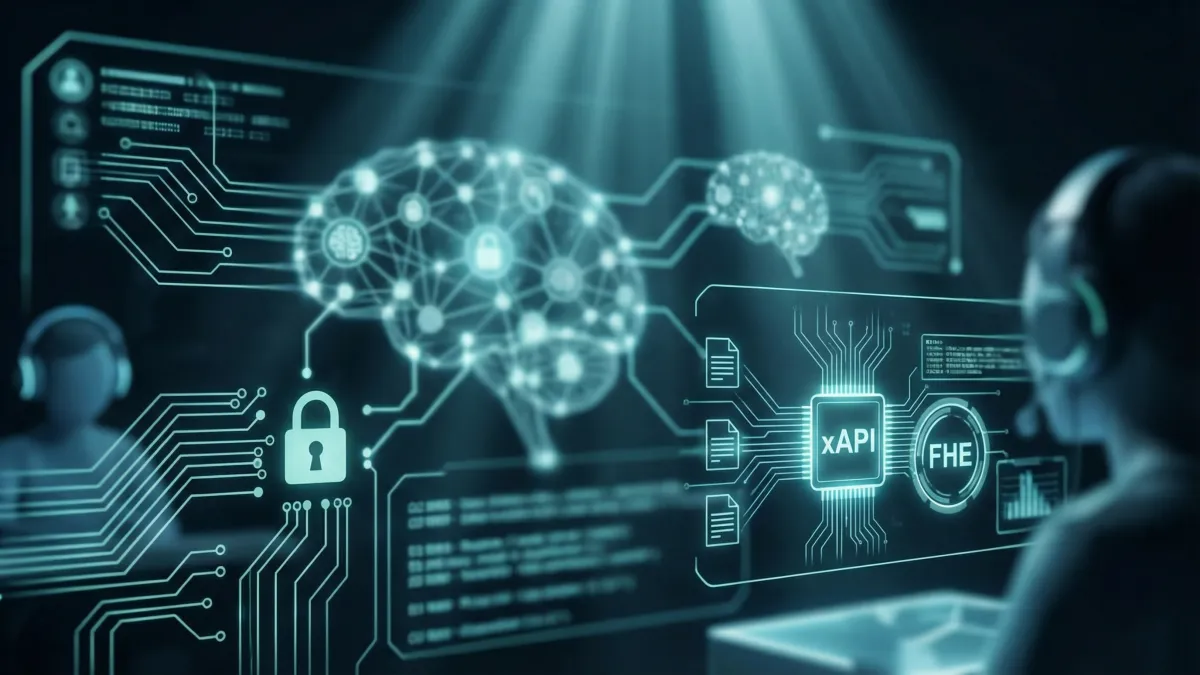
On paper, the proposed stack is an elegant piece of engineering. It relies on a tripartite architecture. First, you have xAPI-compliant Learning Record Stores (LRS). xAPI standardizes student telemetry into a simple Actor-Verb-Object format (e.g., "Dexter-completed-module-four").
Second, you apply FHE as the cryptographic layer. FHE is often viewed as the holy grail of cryptography because it allows data to remain encrypted even during active computation.
Finally, you bring in the adaptive AI models. Compiled with libraries like Zama's Concrete ML or Microsoft SEAL, these AI models ingest the ciphertext to map out personalized curriculum pathways. The AI spits out an encrypted recommendation, which is sent back to the student's device and decrypted locally. The central server and the AI never see the plaintext Personally Identifiable Information (PII).
We are already seeing this in the wild. The Career Development Institute (CDI) recently documented the deployment of an Adaptive Learning Assistant LMS developed by NASMAK Technologies, which pairs xAPI analytics with FHE for real-time cognitive modeling. Peer-reviewed research from IEEE has also successfully modeled using xAPI and Caliper standards within an LRS to conduct these privacy-preserving analytics.
It sounds like a flawless system. It solves the utility versus privacy trade-off, protects against model poisoning, and enables cross-institutional data collaboration. But the moment you try to scale this beyond an advanced pilot phase, the cracks start to show.
The scalability and latency reality check
Let’s talk about the elephant in the server room: computational overhead.
FHE is notoriously heavy. Performing complex AI computations on encrypted data introduces massive latency and requires significant hardware acceleration. We are talking about an industry—education—that routinely struggles to secure funding for basic Chromebooks and stable Wi-Fi. Who is going to foot the cloud computing bill for military-grade cryptographic AI processing?
When you apply FHE to real-time adaptive learning, the "real-time" part becomes highly subjective. If a student finishes a quiz and the system needs to route them to the next appropriate module, any noticeable latency ruins the user experience. You lose the flow state that adaptive learning is supposed to create.
Furthermore, we cannot ignore the environmental impact. Running advanced AI models is already incredibly resource-intensive. Forcing those models to crunch ciphertext via FHE multiplies the required compute exponentially. Recommending a math worksheet to a tenth grader shouldn't require the carbon footprint of a small cryptocurrency mining operation.
The auditing nightmare of black-box pedagogy
Beyond the hardware bottlenecks, there is a fundamental issue with applying encrypted, "black box" AI to education: pedagogical auditing.
In January 2026, academic frameworks were published demonstrating how FHE could be applied to student data for verifiable assessment and personalized feedback. The claim is that AI models and regulators can compute grades and verify fairness directly on encrypted records, ensuring ethical compliance without inspecting plaintext submissions.
But how do educators actually verify the efficacy of an AI model if they can't see the data it's learning from? If an adaptive model starts pushing biased curriculum pathways or unfairly grading specific cohorts, debugging that system becomes a cryptographic nightmare. We are essentially asking teachers and regulators to trust the mathematical proofs of fairness rather than allowing them to intuitively review the raw data and the AI's logic.
Practical innovation or an expensive science experiment?
I am fully on board with the end goal here. Decentralized learner wallets and unbiased algorithmic curriculum generation represent a massive step forward for educational equity. Moving away from vulnerable data lakes is non-negotiable in the current regulatory environment.
But the current push for an xAPI-FHE stack feels premature. It is a highly disruptive concept that currently lacks the underlying hardware efficiency to make it viable at scale. Until the computational costs of FHE drop significantly and we figure out how to transparently audit encrypted pedagogical AI, this "Future Tech Stack" is going to remain an incredibly expensive science experiment reserved for well-funded pilots.
Innovation in EdTech should ultimately serve the learner and the educator. Right now, this stack feels like it was built to serve the compliance departments.
References
- https://digitalprivacy.ieee.org/publications/topics/homomorphic-encryption-use-cases/
- https://journal.ahima.org/page/moving-beyond-traditional-data-protection-homomorphic-encryption-could-provide-what-is-needed-for-artificial-intelligence
- https://csrc.nist.gov/projects/pec/fhe
- https://fpf.org/blog/homomorphic-encryption-signals-future-socially-valuable-research-private-data/
- https://learnerstudio.org/wp-content/uploads/2025/10/Learner-Studio-The-Future-Tech-Stack-Reimagining-Requirements-for-Learner-Centered-Futures.pdf
- https://therisk.global/guide/integrated-learning-account-ila/
- https://cardev.org/technology-whitepaper/
- https://www.computer.org/csdl/journal/lt/2017/01/07563858/13rRUwkfAVM
- https://www.researchgate.net/publication/399721263_Homomorphic_Encryption_for_Confidentiality_in_Student_Performance_Data_and_Financial_Credit_Evaluations
- https://pmc.ncbi.nlm.nih.gov/articles/PMC12926099/