Thursday 2 April 2026, 11:03 AM

How Microsoft's DXR 2.0 eliminates CPU bottlenecks with GPU-driven geometry clustering
Discover how Microsoft's March 2026 DXR 2.0 update uses PTLAS and indirect acceleration to shift geometry clustering to the GPU, eliminating CPU bottlenecks.
For years, we've treated the CPU as the necessary evil in the ray tracing pipeline. It has acted as the ultimate middle manager, orchestrating bounding volume hierarchies (BVH) and stalling the GPU while it catches up to the math. In the tech industry, we constantly talk about removing friction to scale systems, and rendering pipelines are no different. With the March 2026 release of the DirectX Ray Tracing (DXR) Functional Specification Part 2, Microsoft has essentially fired the middle manager.
By shifting geometry clustering directly to the GPU, DXR 2.0 represents a structural platform shift in real-time rendering. But beneath the impressive technical specifications, this update introduces a fascinating market dynamic. It creates a clear dividing line between the studios that can afford to adapt and the legacy hardware that will be left behind.
The mechanics of the new pipeline
Under the hood of the new Shader Model 6.10, Microsoft introduces three core pillars: Clustered Geometry, Partitioned Top-Level Acceleration Structures (PTLAS), and Indirect Acceleration Operations.
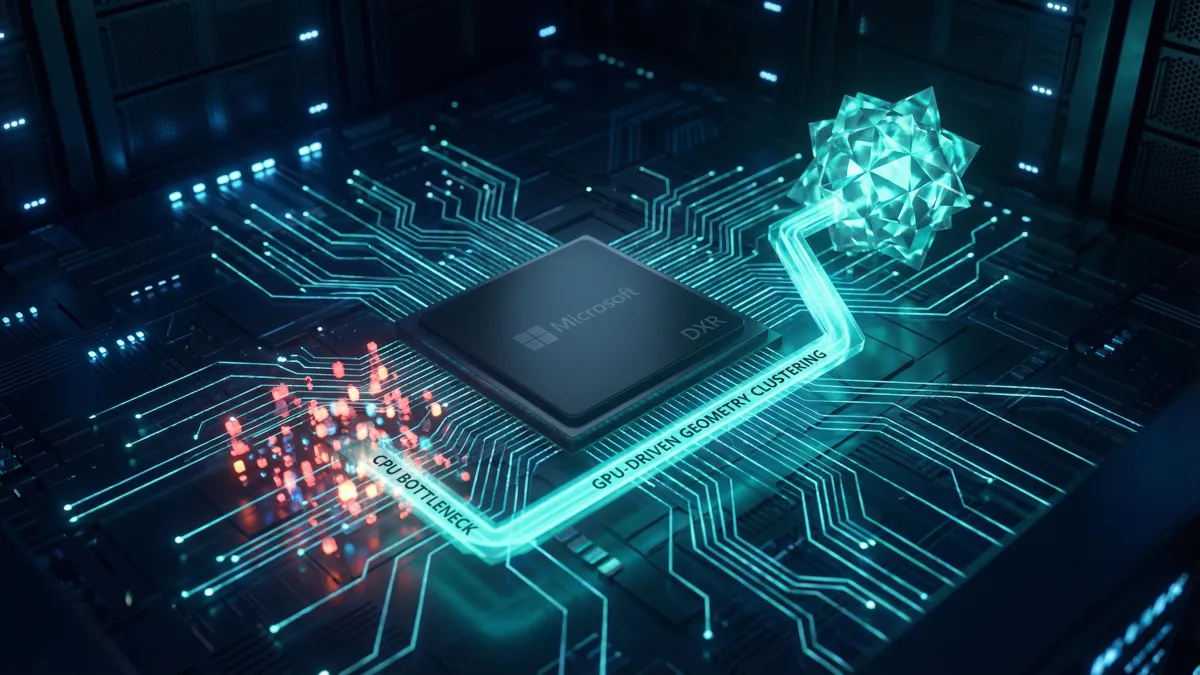
Instead of the CPU building and updating the scene graph, the GPU's command processor takes autonomous control. It groups triangles into meshlet-like clusters and updates only the partitions that actually change. From an architectural standpoint, I love the elegance of this. Moving operations closer to the metal and eliminating redundant data transfers between the CPU and GPU is exactly how you optimize for scale. It frees up the CPU for other complex tasks—like advanced AI or simulation logic—while letting the GPU do what it does best.
Solving the foliage problem and finding product-market fit
If you've ever looked at path-traced games and wondered why the dense forests often feel static, it's because updating millions of swaying leaves historically crushed the CPU. DXR 2.0 directly solves this notorious "foliage problem."
At GDC 2026, CD Projekt Red confirmed they are actively integrating PTLAS-based systems into The Witcher 4. By only updating the specific partitions containing moving foliage and ignoring the static terrain beneath it, they are drastically cutting VRAM and bandwidth usage.
This is a textbook example of product-market fit. Gamers demand fully dynamic, path-traced open worlds, and developers desperately need the performance overhead to deliver them without melting consumer hardware. By isolating dynamic updates, the new DXR standard aligns user expectations with technical feasibility.
Who wins and who loses in the DXR 2.0 era?
Looking at the ecosystem, NVIDIA is the obvious early winner. They unveiled "RTX Mega Geometry" at GDC, offering native hardware support for these exact DXR specifications on their newly announced GeForce RTX 50-series "Blackwell" RT cores. They saw where the software standard was heading and built the silicon to catch it, solidifying their dominant position in the high-end GPU market.
AAA studios with massive R&D budgets are also reaping immediate rewards. Remedy Entertainment demonstrated this by retroactively applying RTX Mega Geometry to Alan Wake 2. The result? A 5 to 20 percent frame rate improvement and a 300 MB reduction in VRAM usage. That kind of optimization is massive. Remedy is already doubling down, announcing that their upcoming 2026 title, Control Resonant, will launch natively with RTX Mega Geometry, advanced path tracing, and DLSS 4.5.
But platform shifts always have casualties. The losers here are the mid-tier and indie developers, alongside consumers holding onto older hardware. Transitioning to this GPU-driven approach isn't a simple patch; it requires a fundamental engine rewrite. Smaller studios simply don't have the capital or engineering bandwidth to overhaul their pipelines overnight.
Furthermore, we are looking at a serious risk of hardware fragmentation. Games built natively to leverage Blackwell's hardware accelerators and DXR 2.0 will have to rely on older, less efficient software fallbacks for legacy GPUs. We are entering a two-tier ecosystem.
Ultimately, DXR 2.0 is a massive leap forward for rendering efficiency. The studios that can afford to absorb the technical debt of rewriting their pipelines will deliver unprecedented visual fidelity. But as we transition into this fully path-traced future, expect a messy adoption curve where only the most well-resourced players set the new standard.
References
- https://microsoft.github.io/DirectX-Specs/d3d/Raytracing2.html
- https://microsoft.github.io/DirectX-Specs/d3d/Raytracing.html
- https://asawicki.info/news_1801_directx_12_news_from_gdc_2026_-_my_comments
- https://www.techpowerup.com/347491/microsoft-reveals-next-gen-directx-ray-tracing-clustered-geometry-partitioned-tlas-and-gpu-driven-acceleration-ops
- https://developer.nvidia.com/blog/nvidia-rtx-innovations-are-powering-the-next-era-of-game-development/
- https://www.techpowerup.com/347245/nvidia-announces-rtx-mega-geometry-implementation-in-witcher-4-path-tracing-for-007-first-light
- https://www.digitalfoundry.net/articles/digitalfoundry-2025-rtx-mega-geometry-in-alan-wake-2-improved-faster-more-efficient-ray-tracing
- https://overclock3d.net/news/software/control-resonant-will-be-nvidias-next-big-rtx-showcase/
- https://gamingtrend.com/news/control-resonant-will-take-advantage-of-nvidia-dlss/
- https://developer.nvidia.com/blog/nvidia-rtx-mega-geometry-now-available-with-new-vulkan-samples/
- https://www.reddit.com/r/hardware/comments/1hx9hqu/rtx_mega_geometry_is_massively_underappreciated/