Wednesday 23 September 2026, 02:05 PM

How the STARE pipeline brings self-calibrating neuromorphic vision to spacecraft
The STARE pipeline uses the EVK4-HD neuromorphic camera for 50 Hz spacecraft attitude determination, solving thermal deformation via dynamic self-calibration.
Satellites are essentially flying servers, and just like the racks sitting in a Santa Clara data center, they hate physical stress. But in orbit, a spacecraft has to execute rapid maneuvers while enduring wild temperature swings. Traditional Active Pixel Sensor cameras—the standard hardware used for star trackers—struggle with this environment. If a satellite spins too fast, the camera suffers from motion blur, losing its celestial point of reference and triggering a "lost-in-space" failure mode. A paper published this past September in the Journal of Physics (Volume 3314) outlines a workaround that ditches standard photography altogether.
Solving the motion blur problem with event-based vision
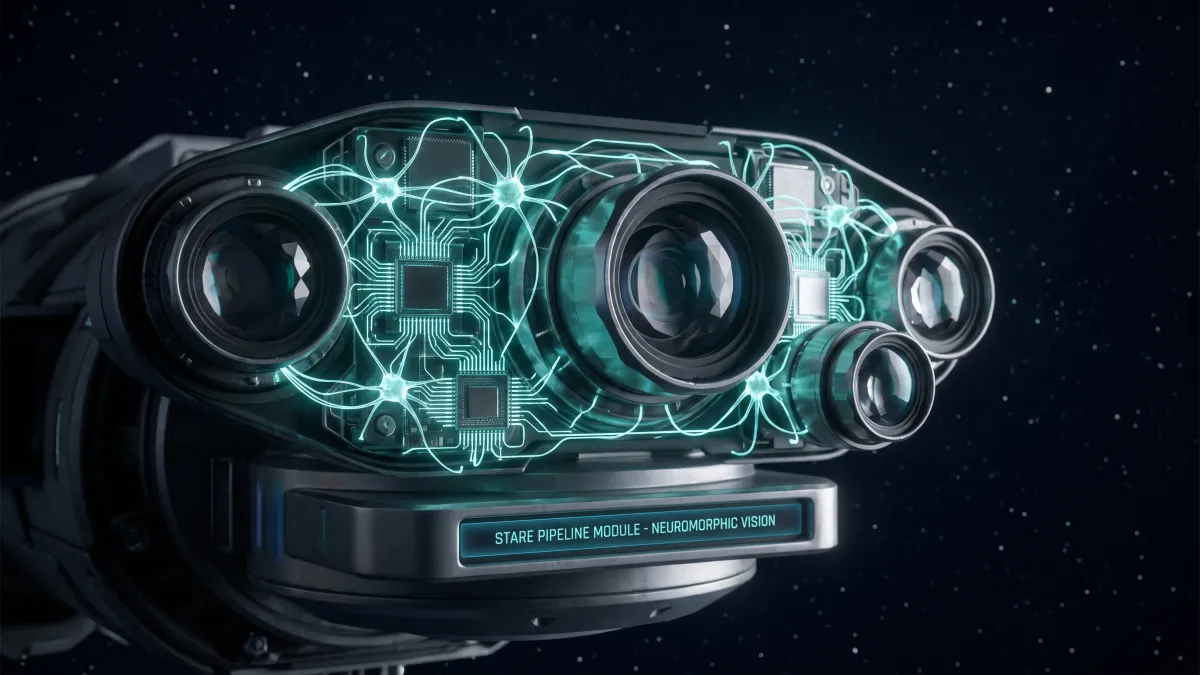
The STARE pipeline, introduced by a research team led by Zhaoxiong Li and Guopeng Ding, shifts spacecraft attitude determination from traditional imaging to neuromorphic vision. The physical validation for their research relies on the Prophesee EVK4-HD evaluation kit. I always enjoy seeing what developers can squeeze out of off-the-shelf evaluation boards, and this one is powered by a Sony IMX636 event-based sensor.
Instead of capturing full-frame photos at a set frame rate, this 1280x720 sensor uses a 4.86 μm pixel pitch to record only asynchronous pixel-level brightness changes. Think of it as a camera that literally only sees change. If a star is static, the sensor registers nothing. But as the spacecraft moves, the sensor tracks the shifting light with microsecond resolution and a dynamic range exceeding 120 dB. Because it ignores static data, motion blur is physically impossible. We are looking at hardware that could make highly autonomous docking procedures or precise orbital debris tracking much easier to pull off, simply because the sensor refuses to get dizzy during high-speed maneuvers.
Dynamic self-calibration in orbit
Space also physically warps our lenses. Extreme thermal gradients in orbit cause optical deformation, which alters a camera's focal length. When that happens, standard angular-distance matching algorithms fail, and the star tracker goes blind.
The STARE pipeline addresses this with a golden-section multi-scale focal-length search. The software dynamically recovers and mathematically compensates for focal length deviations of up to ±20% during live star tracking. From an engineering perspective, using algorithmic calibration to fix physical hardware deformation on the fly is a highly practical workaround. You just let the lens warp and let the math sort it out. It makes the entire system resilient to the unavoidable thermal realities of space without requiring heavier, expensive thermal shielding.
Millisecond processing and defense sector validation
During tests in a dynamic star simulator across 2,500 time windows, STARE achieved an 84.9% identification success rate with a mean reprojection error of just 1.01 pixels. The system processed these tracking windows in approximately 1 millisecond, maintaining a continuous 50 Hz attitude update rate.
That kind of high-frequency tracking has obvious defense applications. DARPA and AFRL are already funding neuromorphic star trackers for hypersonic tracking and agile smallsat architectures. In 2025, Kitware presented their EBS-EKF algorithm at CVPR using the exact same Prophesee camera, earning an Awardable status from the DARPA Expedited Research Implementation Series (ERIS).
There are still technical bottlenecks to work out before we see widespread adoption. Highly dynamic scenes can trigger "event storms" that overwhelm the sensor, and radiation-induced Background Activity noise remains a persistent threat in orbit. STARE incorporates polarity-aware filtering to clean up this data, pushing event-based tracking closer to flight readiness.
If these self-calibrating event cameras can reliably handle the radiation and thermal stress of orbit, they will likely become the primary attitude determination and control systems for proliferated Low Earth Orbit architectures within the next three to five years. Swapping out brute-force thermal shielding for a 1-millisecond algorithmic correction on a Sony sensor is exactly the kind of hardware optimization that makes massive LEO constellations financially viable.
References
- https://www.researchgate.net/publication/414382147_STARE_A_self-calibrating_event-based_star_tracker_for_spacecraft_attitude_determination_with_focal-length_recovery
- https://www.researchgate.net/figure/Bandwidth-latency-trade-off-a-Unlike-frame-based-sensors-event-cameras-do-not-suffer_fig7_380976658
- https://www.kitware.com/kitwares-neuromorphic-event-based-star-tracker-recognized-by-darpa/
- https://www.emergentmind.com/topics/prophesee-evk4-hd-event-camera
- https://www.highergov.com/contract-opportunity/event-based-star-tracker-af222-0010-sbir-78e07/
- https://www.sbir.gov/awards/207353
- https://www.researchgate.net/figure/The-layout-diagram-of-the-star-camera-on-the-satellite_fig3_386496143
- https://kitware.github.io/nest-project-page/
- https://www.prophesee.ai/category/research/
- https://vertexaisearch.cloud.google.com/grounding-api-redirect/AUZIYQHGYRrxCCZUn7JV4WOP7fRVq5mjSu4SSNTKoFmPMfHua4e1C4ZP1zcWPgV77OeBsAYoBO_PvDpRKT14AF5UxgVCePKq8RXbp5yB4BkRTsGt5ZqfJ4ZXOxTHcNy3N9OIIMXg
- https://www.researchgate.net/publication/339290936_Event-based_Vision_A_Survey
- https://vertexaisearch.cloud.google.com/grounding-api-redirect/AUZIYQGN0hftIj1OWVp8FrmALz4cpqL08xufRzyRkUAhv--GFCG7Zp7PGtXHsIJkqtnziwL0VU-DfOPMegOJSdyfBNwAXoNcg31d2y7VyFinrmipyl2MZ8UnY_Vx6V1pdkSm3Yuy
- https://www.sbir.gov/portfolio/363198