Friday 10 July 2026, 04:02 PM

How UEC's NSCC and LLR replace RoCEv2 to fix AI network congestion
Discover how the Ultra Ethernet Consortium uses NSCC and LLR to replace RoCEv2, eliminating head-of-line blocking and packet loss in scale-out AI fabrics.
The bottleneck in our AI ambitions
If you’ve spent any time around the massive GPU clusters powering today’s AI breakthroughs, you know that the compute hardware usually gets all the glory. But in my experience, the real unsung hero—or villain, depending on the day—is the network connecting those tens of thousands of chips.
As we push models into the trillions of parameters, the backend networks have become a critical bottleneck. For years, the industry has leaned heavily on RoCEv2 to approximate the lossless performance of InfiniBand over standard Ethernet. It got the job done for a while, but as synchronized AI workloads like All-Reduce operations scale up, RoCEv2’s cracks are showing. Its reliance on Priority Flow Control (PFC) notoriously leads to head-of-line blocking, congestion spreading, and catastrophic tail latency.
For the end-user—the developers and researchers waiting on these training runs—this translates to a terrible experience. A few dropped packets can mean days of lost time, skyrocketing compute costs, and delayed product cycles. We needed a smarter, more intuitive way to handle traffic jams without punishing the people actually building the AI.
Enter the Ultra Ethernet Consortium
In June 2025, the Ultra Ethernet Consortium (UEC) officially published its 1.0 specification, and it fundamentally changes how we manage packet loss and congestion. By standardizing the Ultra Ethernet Transport (UET), the UEC provided silicon manufacturers with a concrete blueprint to move past the limitations of RoCEv2.
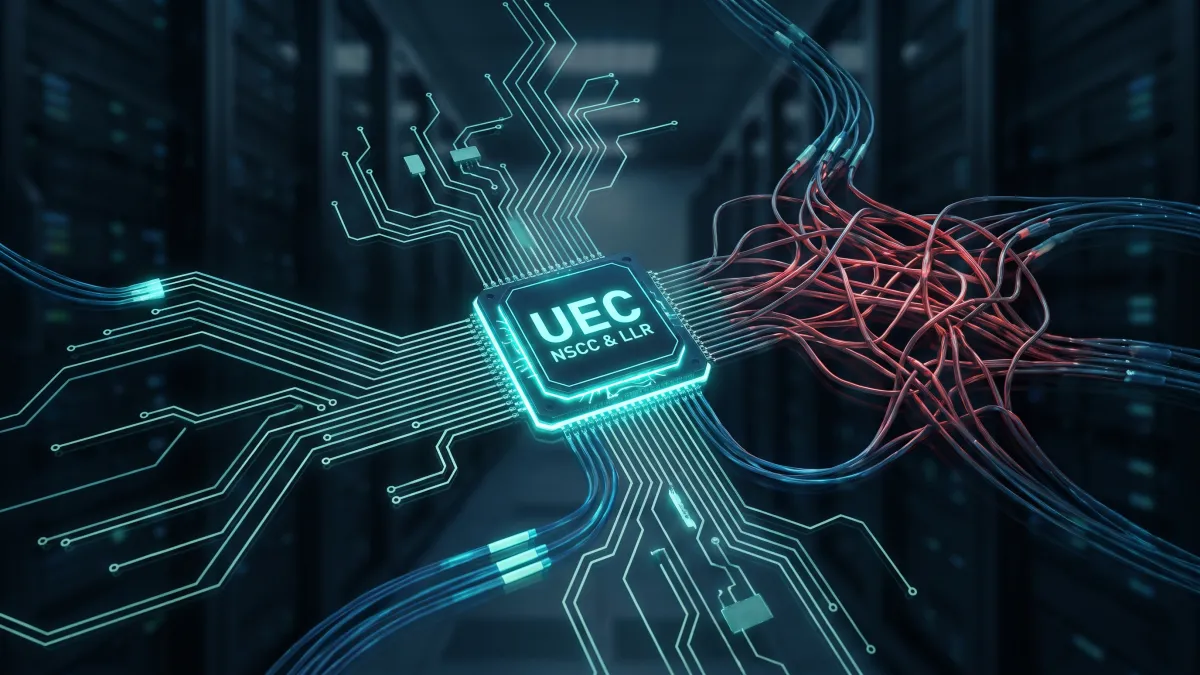
The magic here relies on two major innovations: Network-Signaled Congestion Control (NSCC) and Link Layer Retry (LLR).
Instead of relying on clunky, reactive pauses, NSCC acts as a sender-based, path-aware algorithm. It utilizes fine-grained network delay metrics, Explicit Congestion Notification (ECN), and packet trimming to pace transmission rates at microsecond latency. It’s incredibly intuitive—the network essentially senses congestion and gracefully adjusts its flow before a traffic jam can even form.
Meanwhile, LLR moves error recovery directly to the hardware link layer. By using local sequence numbers to selectively retransmit dropped frames hop-by-hop, LLR completely masks packet loss from the transport layer. When you combine this with Credit-Based Flow Control (CBFC) and packet spraying, the need for PFC is entirely eliminated. Head-of-line blocking becomes a thing of the past. For the developer, the network simply becomes an invisible, flawless fabric that never gets in the way of job completion times.
Real-world viability and brownfield integration
Standards are great on paper, but in the Bay Area, we care about what actually ships. Fortunately, the hardware ecosystem has moved incredibly fast to validate this technology.
At OFC 2026 in March, we saw the industry's first public interoperability demonstration of the UEC specification. Keysight Technologies and Broadcom successfully validated LLR and CBFC operating at a blistering 800GE line rate using Broadcom’s Tomahawk Ultra Ethernet switch. It was a massive proof of concept that this standard is ready for prime time.
But what I find even more crucial for accessibility is what happened earlier in the year. During HPE Discover in January 2026, HPE and VIAVI Solutions ran a demonstration on Juniper QFX5240 switches that proved UET and packet trimming can comfortably coexist with legacy RoCEv2 workloads.
This brownfield integration is a massive win for the industry. Not every company has the capital to rip and replace their entire infrastructure to support next-generation AI. By ensuring backward compatibility, the UEC is lowering the barrier to entry, allowing data centers to transition organically. It democratizes access to high-performance AI infrastructure, ensuring that you don't need to be a hyperscaler to play in the big leagues.
Democratizing the AI fabric
The UEC has also codified a dual-approach to congestion control, pairing the mandatory NSCC on NICs with an optional Receiver Credit-based Congestion Control (RCCC). This flexibility allows AI fabrics to run these mechanisms independently or in tandem, adapting to specific workload requirements. It’s exactly the kind of adaptable, user-centric design we need as AI use cases continue to diversify.
As of mid-2026, the consortium’s growth has been staggering. With over 100 member companies and more than 1,300 active technical participants, the UEC has transitioned from a conceptual working group into the de facto standard-bearer for AI networking.
This shift is monumental. By commoditizing AI infrastructure, hyperscalers and startups alike can build massive, multi-vendor GPU clusters using merchant silicon from companies like Broadcom, Cisco, and Arista. It effectively ends the long-standing Ethernet versus InfiniBand debate. More importantly, it creates a more open, accessible, and resilient ecosystem where the network finally works for the developers, not against them.