Monday 11 May 2026, 11:03 AM

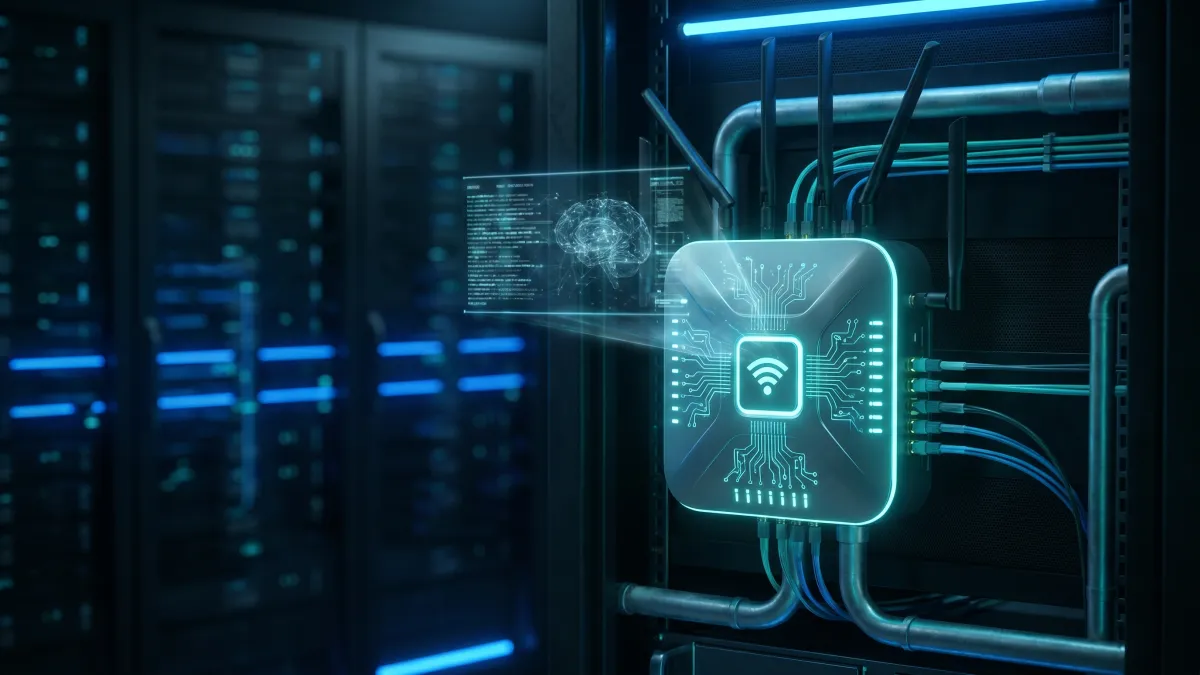
The IEEE 802.11 AI Offload Study Group turns Wi-Fi access points into AI edge nodes
Discover how the IEEE 802.11 AI Offload Study Group is transforming Wi-Fi access points into active edge compute nodes for distributed AI inference workloads.
We've spent the last decade trying to make Wi-Fi routers smarter about how they move packets. Now, the industry is fundamentally flipping the script. Instead of just using AI to optimize Wi-Fi, we are building Wi-Fi to serve AI.
In March 2026, during the Vancouver plenary session, the IEEE officially approved the formation of the 802.11 AI Offload Study Group. Driven heavily by Qualcomm, the foundational proposal passed a Wireless Next Generation (WNG) straw poll with 134 Yes votes, 36 No votes, and 75 abstentions.
When we look at the technical foundation for this group—specifically the document "IEEE 802.11-26/0512r3: AI Offload Standardization" submitted by Qualcomm researchers Rolf de Vegt, George Cherian, and Jerome Henry—it becomes clear that this isn't just an incremental protocol update. We are looking at a paradigm shift that turns traditional access points (APs) into active edge compute nodes.
The shift to Compute-as-a-Service at the MAC layer
Generative AI workloads are breaking our current network architectures. They generate uplink-heavy, uncacheable traffic that requires sub-20-millisecond latency for applications like AR/VR and robotics. If you've spent any time working on hardware for these edge devices, you know the constraints: local client devices quickly hit thermal and battery walls when running complex models, but offloading to the cloud introduces latency penalties that break real-time user experiences.
The IEEE 802.11 AI Offload Study Group is proposing a "Compute-as-a-Service" framework operating directly at the MAC/PHY layers. By offloading compute-intensive inference tasks to mains-powered APs, we can bypass the local power constraints of mobile clients while avoiding the round-trip latency of cloud processing. It keeps sensitive inference workloads on-premises, which is a massive win for data privacy, and it gives ISPs and enterprise networks a new way to monetize compute cycles.
Silicon is already beating the standard to market
Protocol standardization usually lags behind silicon, and this time is no different. We are already seeing vendors preempt the standard with hardware capable of supporting these decoupled architectures.
Take Broadcom's January 2026 introduction of the BCM4918 Wi-Fi 8 chipset. They integrated a quad-core Arm v8 CPU and a dedicated Broadcom Neural Engine (BNE) directly into the AP silicon. From an engineering perspective, this is a delicate balancing act. The access point must function as an edge compute node without degrading standard packet routing performance. You can't have your network drop frames just because the router is busy crunching a local LLM prompt. Integrating dedicated neural engines alongside the primary CPU is the only viable way to isolate these workloads at the hardware level.
MAC-layer modeling and spectrum contention
The real architectural bottleneck isn't the silicon; it's the protocol overhead. In late April 2026, academic researchers started publishing frameworks on arXiv detailing "Task Decomposition and Planning" for LLM inference over AI-enabled Wi-Fi networks.
These papers are tackling the exact problem engineers will face when implementing this standard: complex MAC-layer modeling. If we are splitting reasoning tasks between a client device and an access point, we have to manage Wi-Fi spectrum contention meticulously. Multi-node execution introduces wireless contention overhead. The study group will have to engineer mechanisms that prevent massive AI inference workloads from starving basic packet routing resources.
Furthermore, achieving seamless heterogeneous interoperability across a heavily fragmented hardware ecosystem is going to be incredibly difficult. We will need robust scheduling algorithms at the MAC layer that can dynamically assess the compute availability of the AP, the battery state of the client, and the current spectrum congestion before deciding where a specific inference task should run.
What to watch at the Antwerp interim session
The AI Offload Study Group is commencing its first formal operations at the IEEE 802 Wireless Interim session in Antwerp, Belgium, from May 10–15, 2026. Following an April 20 call for contributions by Gaurang Naik, the group's inaugural presentation slots are scheduled for May 11 and May 13 to begin drafting the Project Authorization Request (PAR).
For those of us building the next generation of connected applications, the outcomes of these PAR drafting sessions will dictate the architectural constraints we work within for the next decade. If the IEEE can successfully standardize the offloading of AI inference to the network edge without compromising core routing performance, the way we design client-side applications—and hardware—will permanently change.
References
- https://ofinno.com/standards-readout/wi-fis-ai-era-begins-as-the-industry-charts-its-next-generation-march-2026-ieee-802-11-standards-readout/
- https://www.ieee802.org/11/
- https://mentor.ieee.org/802.11/dcn/26/11-26-0659-00-0wng-wng-meeting-minutes-2026-march-vancouver-meeting.docx
- https://www.ieee802.org/11/Reports/aiml_update.htm
- https://arxiv.org/html/2604.21399v1
- https://www.ieee802.org/11/Reports/wng_update.htm
- https://www.researchgate.net/publication/404144012_A_Task_Decomposition_and_Planning_Framework_for_Efficient_LLM_Inference_in_AI-Enabled_WiFi-Offload_Networks
- https://mentor.ieee.org/802.11/documents?is_dcn=DCN%2C%20Title%2C%20Author%20or%20Affiliation&is_group=0wng
- https://grouper.ieee.org/groups/802/11/email/stds-802-11/msg09338.html
- https://www.allaboutcircuits.com/news/broadcom-intros-wifi-8-chipset-ai-processor-smart-homes/
- https://iotworlds.com/the-enterprise-wireless-stack-unlocking-ai-at-the-edge/