Tuesday 28 July 2026, 09:03 PM

Inside the BOHR satellite: The dawn of commercial nuclear power in space
Discover how City Labs' BOHR satellite, launched in July 2026, uses NanoTritium betavoltaic technology to pioneer commercial nuclear power in space.
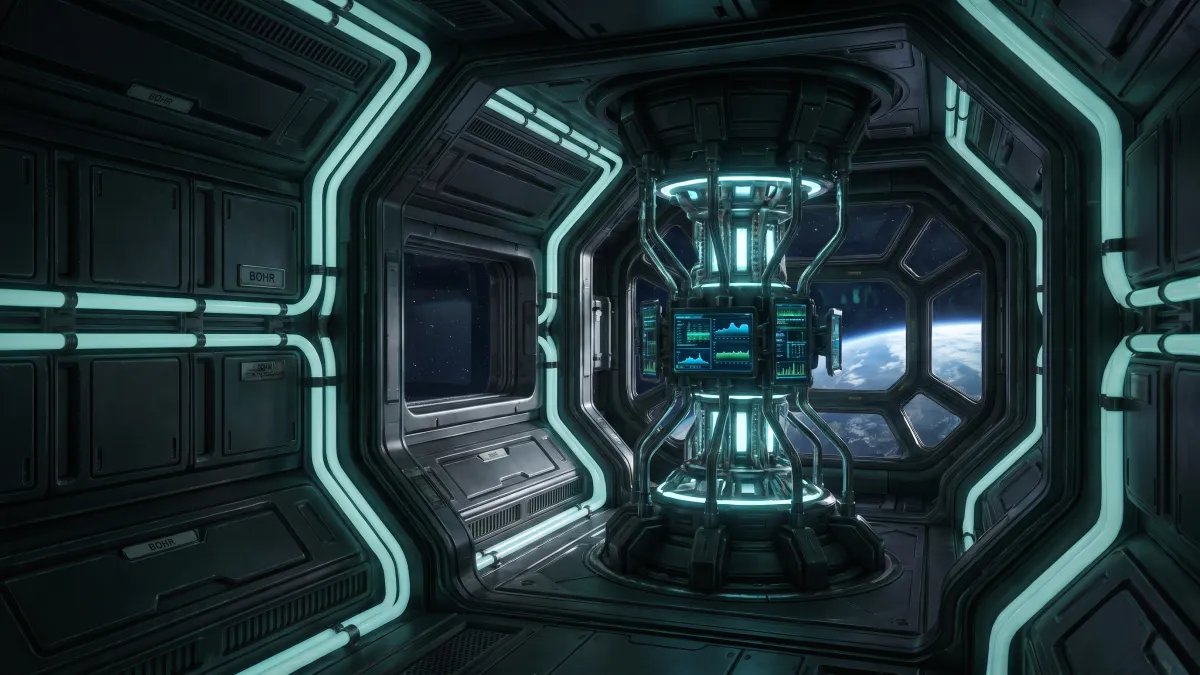
I’ve spent the better part of a decade watching Silicon Valley obsess over software scalability, but sometimes the most profound paradigm shifts happen in hardware—specifically, hardware floating 300 miles above our heads. On July 7, 2026, a SpaceX Falcon 9 lifted off carrying the Transporter-17 rideshare mission. Tucked among the 81 payloads was a softball-sized CubeSat called BOHR. Built by City Labs, it didn’t just reach Low Earth Orbit; it quietly ushered in the commercial nuclear space age.
Breaking the solar dependency
We talk a lot about the "power problem" in tech, usually complaining about battery life on our devices or the energy grid powering our data centers. In space, the power problem is existential. Solar panels are useless in the dark, and chemical batteries degrade fast when temperatures plummet. If we’re looking at a future where commercial enterprises and NASA’s Artemis program are building autonomous networks on the moon—where hardware has to survive a brutal 14-day lunar night—we need something that doesn’t rely on the sun.
Enter the Betavoltaic Orbital High-Reliability (BOHR) satellite. Historically, space nuclear power meant massive, expensive Radioisotope Thermoelectric Generators (RTGs) packed with decaying Plutonium-238, strictly controlled by government agencies. City Labs took a completely different, highly elegant approach with NanoTritium betavoltaics.
Instead of capturing heat, their custom III-V semiconductor junction converts low-energy beta particles from decaying Tritium (Hydrogen-3) directly into a continuous electrical current. By storing the tritium in solid-state metal hydrides, they’ve mitigated outgassing risks in Low Earth Orbit and created a maintenance-free power source capable of operating in extreme temperatures (-40°C to +80°C) for over two decades. Right now, it's pushing ultra-low power in the microwatt range, but it's a continuous, unbreakable trickle. In the UX of space hardware, reliability and longevity often beat peak output.
The regulatory API for space nuclear power
To me, the most fascinating part of the BOHR mission isn’t just the physics; it’s the regulatory precedent. Anyone who has tried to launch hardware knows that red tape can kill a project faster than a failed prototype.
In September 2025, the FAA issued an affirmative payload authorization for BOHR under 14 CFR §450.43, classifying it as a Tier I nuclear payload (permitting up to 10,000 Curies of tritium activity). Because City Labs and Sandia National Laboratories proved the risk profile was exceptionally low—demonstrating that public radiation exposure would stay below 1 mrem even in worst-case launch or reentry failures—the FAA granted an exemption from requiring a massive, complex Probabilistic Risk Assessment (PRA).
This is a massive win for the ecosystem. City Labs essentially just open-sourced the regulatory template for commercial nuclear payloads. By streamlining the approval process, they’ve lowered the barrier to entry for everyone else. It’s the equivalent of Stripe simplifying payment processing, but for orbital nuclear power. We now have a predictable, navigable framework to put sustainable power sources into orbit.
Looking at the next decade
So, where does this put us on the 5-to-10-year horizon? The defense sector is already moving to capitalize on this. City Labs recently secured a $3.8 million SBIR Phase II/III contract from the Department of the Air Force to develop a 100-microwatt power source for Autonomous Nuclear Tritium Sensors (ANTS). This means stealthy, long-duration Space Domain Awareness operations that don't need giant, radar-reflecting solar arrays.
But the real inflection point will be scaling this technology up. Through a $1.5 million DARPA Rads to Watts contract, City Labs is partnering with Microlink Devices to research advanced metal hydrides, aiming to push tritium density to a power density of 10 W/kg. Transitioning from microwatts to watt-class radiovoltaic cells changes the game entirely.
We are looking at a future where deep-space autonomous networks, lunar rovers, and off-grid orbital infrastructure can power themselves silently and safely for decades. It’s a practical, scalable solution to one of aerospace's biggest bottlenecks. The commercial nuclear space economy is officially open for business, and we are just scratching the surface of what we can build on top of it.
References
- https://www.world-nuclear-news.org/articles/first-commercial-nuclear-powered-satellite-launched
- https://www.mobilityengineeringtech.com/component/content/article/55503-first-commercial-nuclear-powered-satellite-tests-tritium-betavoltaic-power-in-orbit
- https://www.space.com/space-exploration/launches-spacecraft/spacex-just-launched-the-1st-ever-nuclear-powered-commercial-satellite
- https://citylabs.net/technology-overview/
- https://www.autonocion.com/us/us-company-satellite-nuclear-battery/
- https://www.sbir.gov/portfolio/406666
- https://thenextweb.com/news/city-labs-bohr-first-commercial-nuclear-power-space
- https://f.hubspotusercontent30.net/hubfs/20928986/NanoTritium%20Battery%20Spec%20Sheet%20P100a%20%205-4-21.pdf
- https://gizmodo.com/commercial-spaceflight-just-entered-the-nuclear-age-2000782443
- https://www.spaceconnectonline.com.au/satellites/7169-worlds-first-commercial-nuclear-powered-satellite-heads-into-orbit-aboard-spacex-mission
- https://www.tomorrowsworldtoday.com/space/spacex-launches-worlds-first-nuclear-powered-satellite-to-orbit/
- https://payloadspace.com/transporter-17-sends-the-first-commercial-nuclear-sat-to-orbit/
- https://arc.aiaa.org/doi/10.2514/6.2026-1345
- https://finance.biggo.com/news/d7d5c43e-0058-426d-8a43-8c936c9bbdbc
- https://www.ans.org/news/article-8188/first-commercial-nuclear-satellite-launched-on-spacex-mission/
- https://acsp.space/snp/
- https://spacedaily.com/sd-in-july-2026-a-miami-startup-called-city-labs-sent-a-softball-sized-cubesat-carrying-a-tritium-battery-into-orbit-on-spacexs-transporter-17-rideshare-becoming-the-first-commercially-built-nucle/
- https://aviationweek.com/space/satellites/city-labs-tiny-nuclear-battery-powered-satellite-aims-set-precedent
- https://newatlas.com/space-systems/worlds-first-commercial-nuclear-powered-payload-orbit/