Saturday 2 May 2026, 11:03 AM

Inside ISPTech's HIP_11: The non-toxic hypergolic fuel replacing hydrazine
Discover how ISPTech's HIP_11 propulsion system uses a non-toxic hydrogen peroxide and ionic liquid mix to replace toxic hydrazine in satellite maneuvering.
The hydrazine problem and the HIP_11 pitch
Anyone who has spent time around aerospace hardware knows the dirty open secret of satellite propulsion: hydrazine is a nightmare. It is highly toxic, corrosive, and heavily regulated. The ground handling costs alone are astronomical because fueling a spacecraft essentially requires a hazmat team. We all know the industry needs to move on, especially with impending regulatory phase-outs and the urgent need for rapid collision avoidance in an increasingly crowded Low Earth Orbit (LEO).
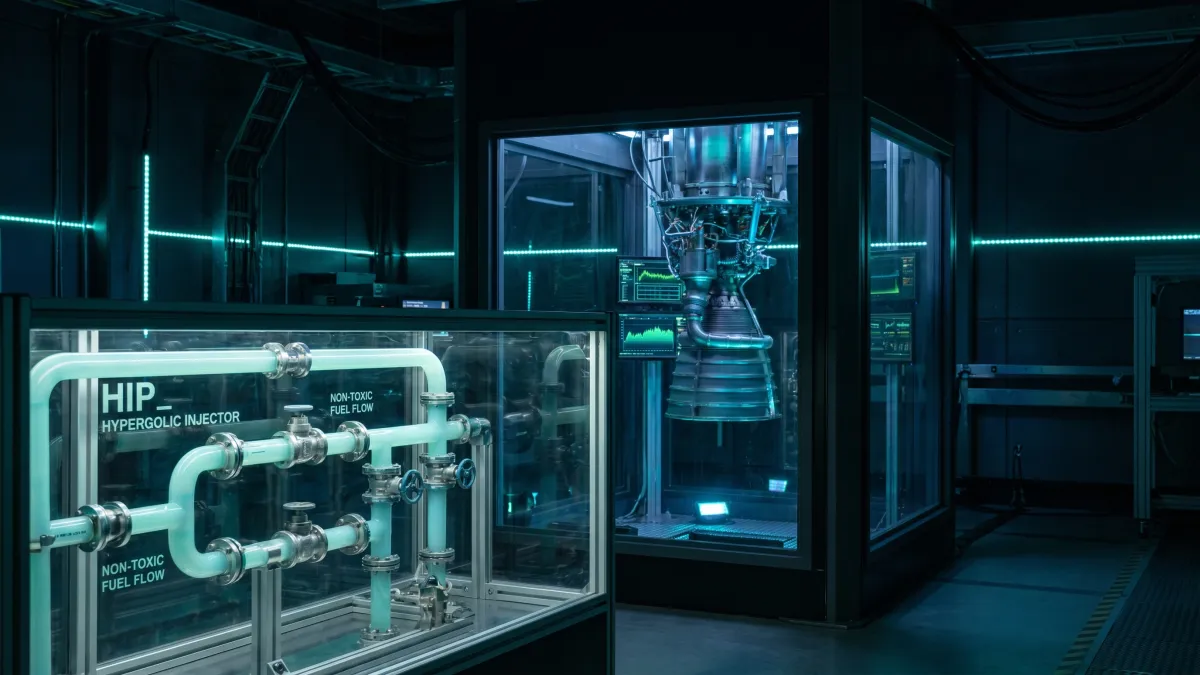
Enter ISPTech. In February 2026, the company closed a €5.5 million seed round led by Join Capital, with backing from High-Tech Gründerfonds (HTGF) and the German Aerospace Center (DLR). The capital is meant to scale their drop-in hydrazine replacement, HIP_11 (Hypergolic Ionic Propellant).
On paper, the chemistry is fascinating. HIP_11 relies on a proprietary, self-igniting mix of highly concentrated hydrogen peroxide (up to 98%) and an ionic liquid-based fuel. Because it is a bipropellant architecture, it bypasses the need for complex ignition systems or catalyst beds. ISPTech claims a specific impulse (Isp) of up to 310 seconds in a vacuum, with better storage density than legacy systems.
They’ve certainly hit their engineering milestones. By September 2025, they reached Technology Readiness Level 5 (TRL 5) after hot-fire testing their 22N thruster at DLR’s M11 vacuum facility in Lampoldshausen. But let’s look past the press releases for a second. TRL 5 is great for a vacuum chamber, but it is a long, expensive road to actual flight heritage.
Dual-mode architecture sounds great, until you build it
One of the standout features ISPTech is pushing is HIP_11's dual-mode capability. The idea is that the same non-toxic fuel and feed system can power both high-thrust chemical maneuvers (for emergency collision avoidance) and highly efficient, low-thrust electric propulsion (for station-keeping).
In software, we’d call this a unified ecosystem. In hardware, I call it a massive integration risk.
Combining chemical and electric propulsion feed systems into a single architectural bottleneck introduces severe complexity. While the pitch is that this will "simplify satellite architectures," plumbing highly concentrated hydrogen peroxide through a dual-purpose feed system sounds like a reliability nightmare waiting to happen in the harsh environment of space. Who is actually asking for this specific dual-mode setup? Most mega-constellations prefer modular, proven, and highly decoupled systems so that a single point of failure doesn't brick a multi-million dollar asset.
Scaling hardware is brutal
The most glaring red flag in ISPTech’s recent announcements is their production timeline. That €5.5 million seed injection is specifically allocated to build an in-house test facility and scale manufacturing. Their stated goal? To increase production from 4-5 units annually to "dozens by the end of the decade."
Dozens. By 2030.
LEO is congested right now. Commercial space companies are churning out satellites by the hundreds every month. If ISPTech is only aiming to produce a few dozen units a year by the end of the decade, who is this actually for? This low-volume trajectory suggests that HIP_11 is destined for boutique, large-scale satellite buses rather than solving the broader commercial LEO bottleneck.
Furthermore, scaling from R&D to commercial production introduces a massive supply chain risk. Sourcing 98% hydrogen peroxide and proprietary ionic liquids at a consistent, aerospace-grade quality isn't trivial. A €5.5M seed round is a respectable start, but in the capital-intensive world of orbital hardware manufacturing, it is barely enough to keep the lights on and build a test stand, let alone secure a global supply chain.
Market validation vs. flight heritage
To give credit where it's due, ISPTech is excellent at securing institutional and commercial buy-in. In May 2025, they were awarded a project under the European Space Agency's (ESA) FLPP-FIRST! Propulsion framework, leading the NewSTyLE consortium alongside OHB, UARX Space, and DLR.
They also signed a formal licensing agreement back in October 2024 with The Exploration Company (TEC), integrating the HIP_11 system into TEC's Mistral 200 N thruster for their Nyx space capsule. To support this, GATE Space delivered a custom test stand for TEC in May 2024 just to handle the unique testing scenarios for this 200 N engine.
The market validation is clearly there. The industry desperately wants a non-toxic hypergolic fuel that works, and they are willing to fund the R&D to get it. But we need to separate institutional enthusiasm from operational reality.
Until HIP_11 actually flies, survives the thermal and radiation extremes of orbit, and proves it can be manufactured at a scale that actually impacts the industry, it remains a highly promising lab experiment. We absolutely need to banish toxic hypergolic fuels from our supply chains. But if the replacement takes half a decade to scale to just a few dozen units, we are going to be stuck with hazmat suits and hydrazine for a lot longer than anyone wants to admit.
References
- https://www.vestbee.com/insights/articles/isp-tech-raises-5-5-m
- https://www.isptech.space/news/exploration-isptech-hip11-license
- https://www.isptech.space/technology
- https://payloadspace.com/isptech-raises-e5-5m-to-scale-green-propulsion-tech/
- https://www.htgf.de/en/isptech-seed-round/
- https://satsearch.co/suppliers/isp-tech
- https://www.isptech.space/news/isptech-pre-seed-funding
- https://www.isptech.space/news/hip-11-22n-thruster-reaches-trl-5
- https://www.isptech.space/news/newstyle-announcement
- https://gate.space/wp-content/uploads/2024/07/Press-Release-The-Exploration-Company-GATE-Space.pdf?utm_source=www.getwormhole.space&utm_medium=referral&utm_campaign=august-15-2024-space-industry-round-up
- https://www.dlr.de/en/ra/about-us/departments/satellite-and-orbital-propulsion/advanced-propellants
- https://redriverwest.substack.com/p/the-exploration-company-igniting
- https://www.exploration.space/blog/sustainability-projects-at-the-exploration-company
- https://www.isptech.space/product
- https://www.isptech.space/