Monday 5 October 2026, 10:05 AM

Matter 1.6 introduces batteryless NFC commissioning for pre-power IoT onboarding
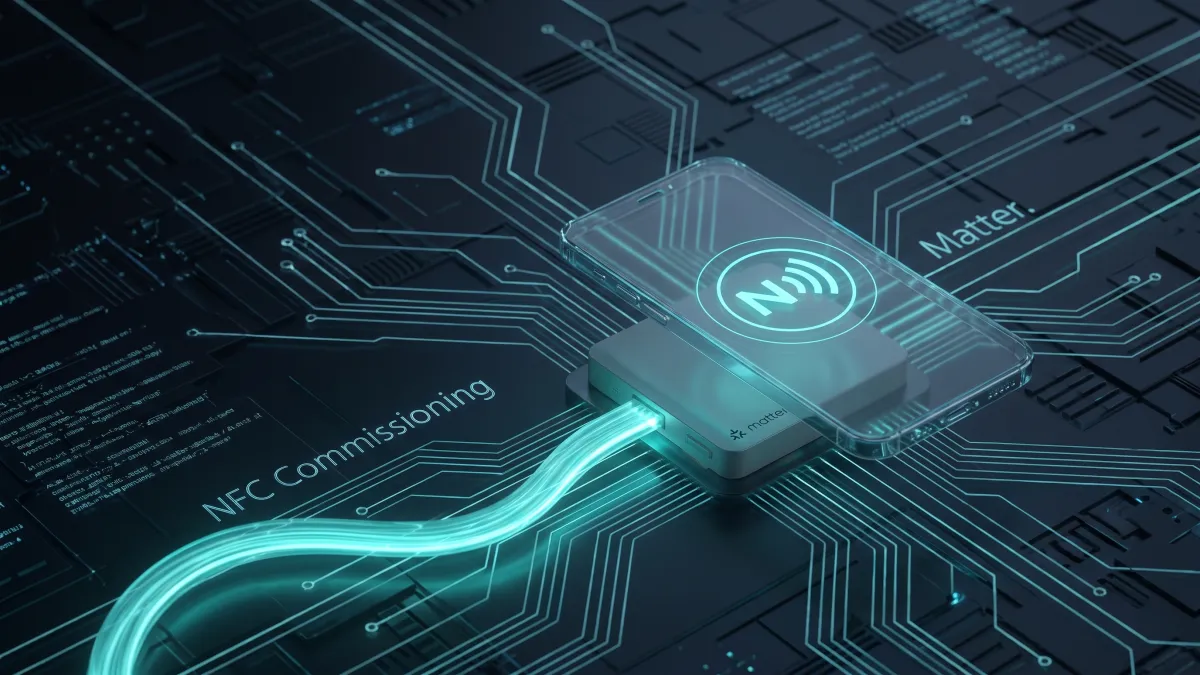
Matter 1.6 introduces bi-directional NFC commissioning, enabling IoT devices to execute cryptographic onboarding without mains power via energy harvesting.
I live in a dense apartment building in San Francisco, which means my local 2.4GHz spectrum is a crowded mess. Setting up a new smart plug usually involves plugging it in, waiting for a blue LED, and hoping my phone's Bluetooth can cut through the interference. The Connectivity Standards Alliance released the Matter 1.6 specification on June 17, 2026, and it addresses this specific onboarding bottleneck. Instead of relying purely on Bluetooth Low Energy for the initial Passcode-Authenticated Session Establishment (PASE) handshake, the update introduces an NFC Transport Layer (NTL) for bi-directional commissioning.
Tactile setup and accessibility
Relying on BLE meant devices had to be powered on and broadcasting. With NTL, users can tap their smartphone directly to the device. From an accessibility standpoint, this is a practical improvement. Users with visual impairments do not need to rely on specific blinking light patterns to verify a device is in pairing mode. The physical tap provides immediate tactile confirmation that the handshake is happening.
Provisioning without mains power
The specification also enables device provisioning without mains power. On September 17, 2026, STMicroelectronics released the ST25DA-C, a secure NFC dynamic tag IC compliant with the 1.6 standard.
These tags contain Secure Elements and harvest energy directly from the RF field of a commissioning smartphone. When a phone comes close, the chip draws enough power to execute the SPAKE2+ cryptographic protocol, verify attestation certificates, and write network credentials to non-volatile memory.
For hardwired hardware like in-wall relays or ceiling fixtures, this removes a specific installation hurdle. Electricians can provision a smart switch while it sits on a workbench, rather than wiring it to live electricity first and troubleshooting a failed pairing on a hot circuit. It also allows for bulk "in-the-box" provisioning for enterprise supply chains.
To support the manufacturing side, STMicroelectronics launched ST MatterConnect. This service acts as a Product Attestation Authority (PAA) to inject custom Device Attestation Certificates (DACs) into the silicon during production.
Joint Fabric and network management
Beyond the physical setup, Matter 1.6 alters how networks are managed across different ecosystems. Previous versions used isolated fabric sharing. This could be cumbersome when mixing Apple Home and Google Home controllers in the same house. The 1.6 update introduces Joint Fabric, a multi-admin architecture that allows multiple user-authorized controllers to co-administer a single shared Matter network.
The CSA also launched Product Security 1.1 alongside this update to assess the security of complete IoT systems, including remote processes and gateways.
Implementation variables
Open-source platforms are already adapting. In June 2026, the Home Assistant project opened Roadmap Issue #215 to target Matter 1.6 compatibility. They are pairing the upgrade with an architectural overhaul for Intermittently Connected Devices (ICDs), which battery-powered Matter sensors require to sleep and conserve power.
Widespread adoption will depend on hardware implementation. The NFC hardware in the 1.6 specification is optional. Budget manufacturers might omit the NFC silicon to reduce bill-of-materials costs, leaving those devices on the older Bluetooth pairing method. Furthermore, major controllers like Apple Home and Google Home still need to update their software stacks to support NTL and the Joint Fabric architecture.
The standard is mature on paper. Now the hardware and software ecosystems have to catch up before the deployment process actually changes.
References
- https://csa-iot.org/newsroom/matter-1-6-enables-more-intuitive-setup-multi-ecosystem-experiences-and-context-driven-control/
- https://www.promptquorum.com/smart-home/matter-1-6-explained
- https://blog.st.com/matter-commissioning-st25da-c/
- https://www.electronics-lab.com/stmicroelectronics-secure-nfc-chip-simplifies-matter-device-commissioning/
- https://academy.nordicsemi.com/courses/matter-fundamentals/lessons/lesson-1-matter-introduction/topic/transport-layers-in-matter/
- https://www.cardinalpeak.com/blog/matter-specification-how-the-matter-smart-home-standard-works
- https://vertexaisearch.cloud.google.com/grounding-api-redirect/AUZIYQEddpYcEECom2dMHFG9-qe97jlKUKBPKJTT4h3QPkUvKIU_PLdTQ_xG2jBYgdpg57deufVoXOs4yMFkqDrLSjeda0JHdSA8LUto1tWVu50l9Wg2C9I6g1vGS69aFzm0Bop8Addfl5qD3pN7pKOmB3edKBtdKtI0w6kGGWgG4Q==
- https://handbook.buildwithmatter.com/how-it-works/commisioning/
- https://docs.silabs.com/matter/2.9.1/matter-overview-guides/matter-commissioning
- https://smarthomefieldguide.com/blog/matter-1-6-update-what-changed/
- https://research.samsung.com/blog/CSA-Matter-1-6-Release-Ambient-Sensing-More-Intuitive-Setup-Multi-Ecosystem-Experiences-and-Context-Driven-Control
- https://9to5mac.com/2026/06/17/matter-1-6-and-product-security-1-1-officially-announced-heres-whats-new/
- https://www.iclarified.com/101222/matter-16-brings-nfc-setup-joint-fabric-and-smarter-thermostats
- https://homekitnews.com/2026/06/17/matter-1-6-released-with-nfc-commissioning-joint-fabric-and-more/
- https://www.macrumors.com/2026/06/17/matter-1-6-specification/
- https://github.com/OpenHomeFoundation/roadmap/issues/215
- https://www.reddit.com/r/MatterProtocol/comments/1u88czt/matter_16_released_joint_fabric_nfc_commissioning/