Saturday 13 June 2026, 03:03 PM

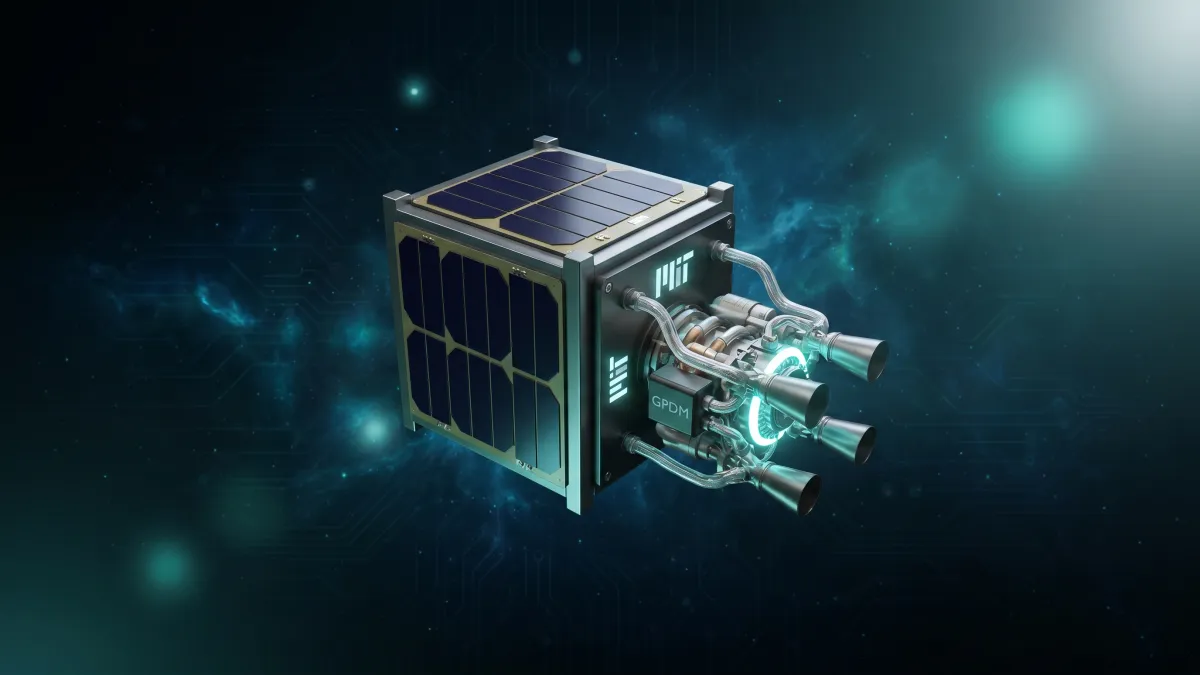
MIT's Green Propulsion Dual Mode (GPDM) system unlocks shared-tank bimodal CubeSat propulsion
MIT's Green Propulsion Dual Mode (GPDM) system enables CubeSats to use both chemical and electric thrusters from a single shared tank of ASCENT propellant.
We love a good life hack in the Bay Area, especially when it involves eliminating a stubborn tradeoff. In the software world, it’s usually the classic "speed versus stability" dilemma. But up in orbit, hardware engineers have been wrestling with a much more physical binary choice for decades: do you want to go fast, or do you want to go far?
Historically, if you wanted the rapid, high-thrust maneuvers of chemical propulsion—perfect for quick orbital insertions or dodging space debris—you had to sacrifice the highly efficient, long-haul endurance of electric propulsion. Trying to fly both on a tiny CubeSat meant cramming two entirely separate, mass-prohibitive tanks and plumbing systems into a chassis the size of a shoebox.
Well, it looks like we don't have to choose anymore.
I’ve been tracking the development of MIT’s Green Propulsion Dual Mode (GPDM) system, and it is shaping up to be an absolute paradigm shift for small satellite architecture. By feeding both chemical and electric thrusters from a single, shared propellant tank, this tech is about to rewrite the playbook for what a 6U CubeSat can actually pull off in space.
The magic of a double-duty propellant
The secret sauce making this bimodal CubeSat propulsion possible is a fascinating liquid called ASCENT (formerly known as AF-M315E).
ASCENT is a "green" hydroxylammonium nitrate-based monopropellant. In the aerospace community, "green" is a massive win because it means the fuel is significantly less toxic and easier to handle than traditional, highly volatile propellants like hydrazine. But the real magic of ASCENT is its dual personality. In a vacuum, it also functions beautifully as an ionic liquid.
This dual nature is what allows the GPDM architecture to work. From one shared tank, you can feed a high-thrust chemical engine and highly efficient electric thrusters.
To handle the chemical side, the system relies on the "Sprite" module, a slick, self-contained unit built by commercial partner Rubicon Space Systems. It features a 3D-printed titanium pressure vessel, an integrated propellant management device, and a 0.1 N ASCENT thruster. Meanwhile, the electric side is powered by MIT’s ion Electrospray Propulsion System (iEPS)—incredibly precise, dime-sized electrospray thrusters that sip the exact same fuel to manage highly efficient station-keeping.
Milestones, levitation, and peer-reviewed proof
Transitioning a wild idea from the whiteboard to the launchpad is where the real fun happens, and the MIT Space Propulsion Laboratory has been moving at an impressive clip.
In early June 2026, the team hit a massive milestone: they officially delivered four flight-unit electrospray thrusters to NASA's Marshall Space Flight Center. These tiny thrusters are now ready for integration into the GPDM mission payload.
What I love about this project is how they validated the concept on Earth. Before handing over the flight hardware, MIT researchers built a custom magnetic levitation testbed inside a vacuum chamber to simulate zero-gravity. They mounted their ASCENT-fueled electrospray thrusters onto a model CubeSat and successfully proved they could spin and maneuver the satellite using nothing but electric fields.
The scientific foundation was also cemented this past June with a peer-reviewed publication in the Journal of Propulsion and Power. Authored by Dr. Amelia Bruno and Prof. Paulo Lozano, the study definitively proved that ASCENT chemical propellant can be successfully utilized within electrospray hardware.
Opening up the deep space playbook
The GPDM mission is officially slated for an orbital launch no earlier than November 2026. Flying aboard a 6U CubeSat, this demonstration will be a historic first for the aerospace industry.
Of course, hardware is hard, and there are still engineering hurdles to clear. Managing the extreme pressure differential between the 275 psi chemical blowdown system and the low-pressure electrospray capillary feed is no small feat, not to mention ensuring strict electrical isolation between the two systems.
But I am incredibly optimistic about the doors this will open. We are looking at a future where commercial-off-the-shelf smallsat buses can execute complex deep space transit and dynamic Earth observation missions that were previously impossible. When you remove the constraints of binary propulsion choices, you give operators the ultimate flexibility to dream bigger, maneuver faster, and stay on mission longer.
I, for one, can't wait to watch this system light up the vacuum of space next year.
References
- https://spacedaily.com/sd-mit-engineers-just-collapsed-the-oldest-tradeoff-in-satellite-propulsion-one-tank-two-thrusters-and-a-quiet-rewrite-of-how-cubesats-are-designed/
- https://www.nanosats.eu/sat/gpdm
- https://spacepropulsion.mit.edu/researchpage/bimodal-propulsion-systems/
- https://thedebrief.org/mit-engineers-testing-exotic-electrospray-propulsion-for-faster-more-maneuverable-spacecraft/
- https://digitalcommons.usu.edu/cgi/viewcontent.cgi?article=5911&context=smallsat
- https://digitalcommons.usu.edu/smallsat/2024/all2024/105/
- https://spacepropulsion.mit.edu/news/spl-delivers-flight-hardware-for-nasa-technology-demonstration-mission/
- https://dspace.mit.edu/entities/publication/eed5d54a-8738-4637-b3ce-4b6aaa797674
- https://www.sciencedaily.com/releases/2026/06/260610003051.htm
- https://news.mit.edu/2026/new-propulsion-system-could-make-tiny-satellites-fast-fuel-efficient-0601
- https://www.universetoday.com/articles/a-green-dual-mode-engine-is-about-to-give-cubesats-the-best-of-both-worlds
- https://www.space.com/technology/thruster-breakthrough-new-2-in-1-propulsion-system-is-about-to-get-an-in-space-test
- https://ntrs.nasa.gov/api/citations/20250008921/downloads/IEPC_495_GPDM_Presentation_v3.pdf
- https://dspace.mit.edu/handle/1721.1/139510