Thursday 29 October 2026, 08:04 PM

Pioneer Labs unveils Mars Seed biofoundry for autonomous Martian habitat construction
Pioneer Labs' Mars Seed architecture uses engineered sPL.001 microbes to convert Martian resources into PHB bioplastics for autonomous habitat construction.
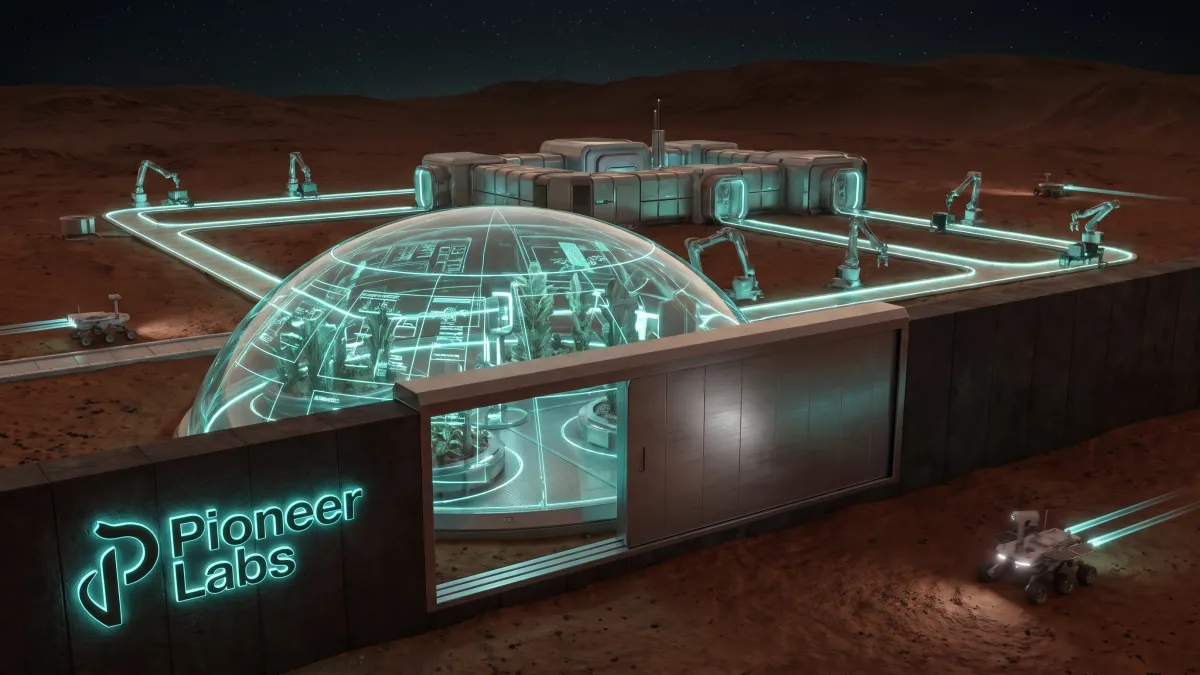
Just across the bay in Emeryville, Pioneer Labs recently dropped a fascinating three-part publication rollout that completely flips how we think about building on Mars. In September 2026, they detailed their Mars Seed reference architecture. The core premise? Using engineered bacteria to autonomously grow Martian habitats before human crews even arrive. It is biological In-Situ Resource Utilization (ISRU), and it makes me wonder why we spent so long obsessing over shipping steel tubes across the solar system.
Usually, off-world construction concepts lean heavily on complex chemical plants or, somewhat grimly, human waste. Pioneer Labs is taking a different route by hacking local Martian resources. They put a bacterial strain called Cupriavidus necator through an intense directed evolution process in the lab—over a trillion cumulative cell divisions. The resulting microbe, dubbed sPL.001, tolerates heavy Martian perchlorates and churns out a three-fold higher titer of polyhydroxyalkanoate (PHA) under simulated Mars conditions compared to its parent strain.
The workflow is wonderfully self-contained. Abiotic systems pull water from Martian ice and capture atmospheric CO2, electrochemically fixing it into acetate. Nutrients are leached directly from the regolith. Inside pressurized bioreactors, the sPL.001 microbes feast on this acetate and produce polyhydroxybutyrate (PHB) bioplastics. The leftover biomass gets mixed with regolith to 3D-print a thick outer radiation shield, while the purified PHB forms the pressurized inner liner of the habitat.
Think about what this actually means for off-world infrastructure. If we can land a 20-ton biofoundry payload—a perfect fit for a SpaceX Starship—and have it pay for its own mass and power costs within two Earth-Mars launch synodic periods, we bypass the tyranny of the rocket equation entirely. We stop bringing the house with us and start bringing the seeds.
But why stop at habitats? If a bioreactor can spit out high-grade bioplastics from dust and ice, what else could we program these biofoundries to grow? Furniture? Rover replacement parts? Medical tools? The moment you turn biology into a manufacturing platform on another planet, the supply chain bottlenecks that usually doom space settlement concepts start to evaporate. You just need the right genetic code and a steady supply of Martian dirt.
To make sure the science actually works outside a spreadsheet, Pioneer Labs partnered with Space Resources Technologies to create Defined Mars Media (DMM). It is a chemically defined simulant that accurately replicates the soluble macro- and micro-nutrients found in Martian regolith. They open-sourced it, giving the broader scientific community a standardized medium for off-world biological research. I love this move. Shared standards are how early-stage tech ecosystems actually gain traction.
Naturally, dumping Earth microbes on Mars triggers immediate planetary protection alarms. Pioneer Labs tackled this by publishing the PRIM framework on arXiv to evaluate forward contamination risks, and they engineered sPL.001 with a strict biological kill switch. The microbe is entirely dependent on the heated, pressurized, acetate-rich environment of the bioreactor. If a seal breaks and it hits the Martian surface, it dies rapidly. The spread probability is an exceptionally low 10^-24 per cell.
Right now, this is sitting at a laboratory proof-of-concept stage (TRL 3-4) and relies heavily on the mechanical reliability of autonomous rovers to feed the system. But CEO Erika Alden DeBenedictis views sPL.001 as just the starting line. They are planning to engineer a total of five foundational "pioneer species" to biologically transition Mars toward long-term habitability.
It is a fascinating shift in strategy. Instead of trying to conquer a dead planet with brute-force engineering, we might end up coaxing it to life, one vat of engineered bacteria at a time. If we can master this kind of biological bootstrapping for Mars, I find myself wondering how we might eventually apply the same closed-loop principles to fix resource problems right here at home.
References
- https://cdn.prod.website-files.com/663fe24e48d6cafd89990a8c/6ab1b45c1ccf006e4d998d5f_9a37c4713f86e1624f1eb73d4f2ac4de_260921-Mars-Seed.pdf
- https://spacesettlementprogress.com/an-architecture-for-in-situ-production-of-bioplastics-for-habitats-on-mars/
- https://www.youtube.com/shorts/M_aVuV4q9KQ?app=desktop
- https://www.biorxiv.org/content/10.64898/2026.09.14.748363v1
- https://wireunwired.com/wireunwired-story/pioneer-labs-researchers-engineer-a-new-microbe-named-spl-001-to-help-humanity-settle-mars/
- https://www.securities.io/building-martian-habitats-might-be-more-efficient-with-bacteria/
- https://spacesettlementprogress.com/
- https://spacesettlementprogress.com/2026/10/
- https://wisevoter.com/world/2026/09/23/pioneer-labs-engineered-bacteria-mars
- https://arxiv.org/html/2609.12015v1
- https://www.pioneer-labs.org/news
- https://www.biorxiv.org/content/10.64898/2026.04.24.719001v2
- https://www.erikadebenedictis.com/
- https://astera.org/resident/erika-alden-debenedictis/
- https://www.mundoamerica.com/entertainment/2026/09/28/6aba36c4e9cf4a81448b459e.html
- http://www.yetianai.com/en/news/30634
- https://entrelligence.com/pioneer-labs-mars-regolith-bioplastic/
- https://vrulum.co.uk/technologies/space-biomanufacturing