Wednesday 4 November 2026, 03:04 PM
Unlocking iridium-free green hydrogen with ether-free PAP membranes in AEM electrolyzers
Ether-free PAP membranes eliminate alkaline degradation in AEM electrolyzers at 80°C, unlocking commercial-scale, iridium-free green hydrogen production.
We talk a lot about scaling software in the Bay Area, but scaling physical energy infrastructure is a different beast entirely. Right now, the green hydrogen industry has a scaling problem that comes down to a single element: iridium.
For years, we have relied on Proton Exchange Membrane (PEM) electrolyzers for compact and fast hydrogen production. The catch is they require iridium to function. You cannot build terawatt-scale energy grids on a metal that barely exists in the Earth's crust. Traditional Alkaline Water Electrolysis is cheap and uses abundant metals, but the equipment is bulky and struggles to respond to the fluctuating power curves of renewable energy sources like wind and solar.
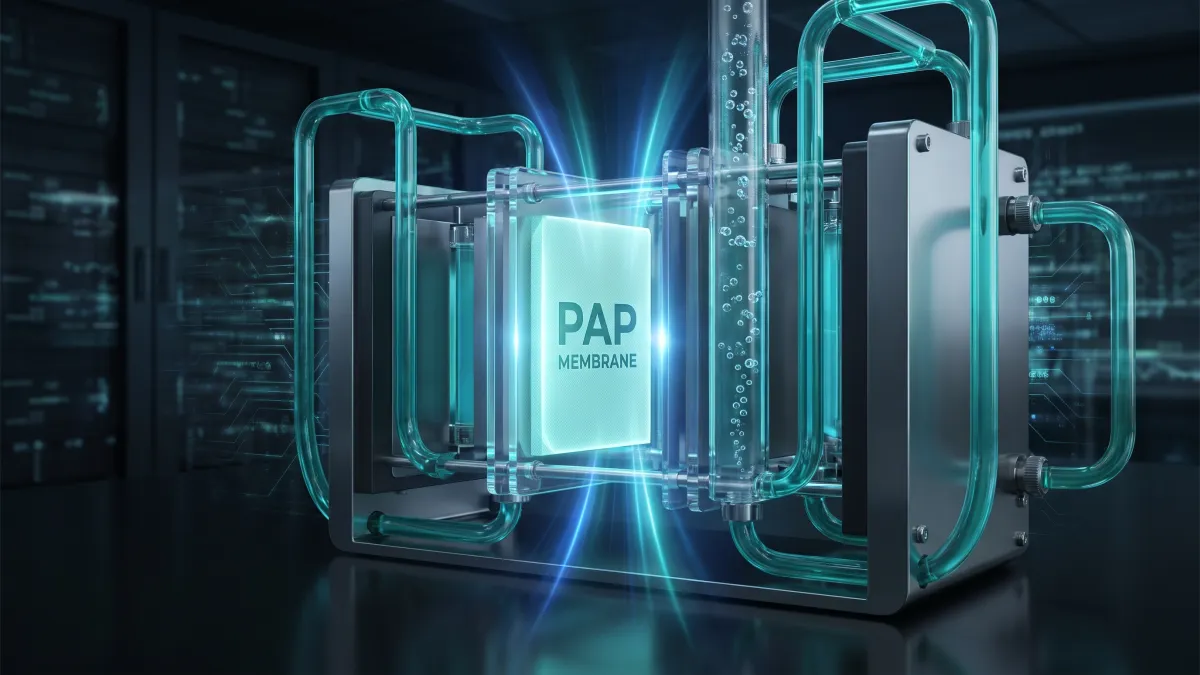
Anion Exchange Membrane (AEM) electrolyzers offer a hybrid approach, combining the low material costs of alkaline systems with the compact footprint and speed of PEM technology. Historically, early polymer membranes would fall apart in hot alkaline environments. Recent data from mid-2026 shows the industry has cracked this chemical bottleneck. Researchers stabilized ether-free poly(aryl piperidinium) (PAP) membranes by eliminating aryl-ether linkages and utilizing piperidinium cations. This allows the membranes to resist nucleophilic attack and Hofmann elimination, meaning the systems can run continuously at 80°C.
When paired with non-noble catalysts like low-crystallite nickel ferrite and NiFe layered double hydroxides, these ether-free PAP membranes hit current densities of 3 A/cm² at 2.2V. That metric matches commercial iridium-based systems directly. Operating in a pH 14 alkaline regime allows us to use earth-abundant transition metals like nickel and iron for the Oxygen Evolution Reaction instead of Platinum Group Metals.
If we zoom out to the five-to-ten-year horizon, decoupling green hydrogen from rare earth metals completely alters the global energy map. Any region with abundant wind or solar can deploy industrial-scale electrolyzers without competing for a severely constrained global supply of iridium.
Moving from lab chemistry to industrial hardware is where things usually stall, but the manufacturing floor is already catching up. Versogen is now producing their PiperION membranes at a capacity of 1 gigawatt per year. Hitting a gigawatt scale proves the commercial viability of the ether-free polymer resin, taking the technology out of the research phase and positioning it as a foundational piece of global decarbonization hardware.
We are also seeing the physical stacks mature. In September 2026, a joint engineering run between Versogen and SimScale validated a 10 kW prototype stack at Technology Readiness Level 6. The engineering team implemented proprietary high-pressure elastomeric seals to prevent hydrogen crossover—a notorious headache in AEM systems. Exceeding the Department of Energy’s 2026 performance targets, this prototype is the direct precursor to a 300 kW commercial module currently in development.
I always look closely at durability when evaluating new hardware, because replacing degraded membranes ruins the Levelized Cost of Hydrogen for hard-to-abate sectors. Extensive testing between 2025 and 2026 confirmed that these membranes retain over 87% of their active cations in hot potassium hydroxide solutions for more than 2,000 hours. Even after 30-day immersion tests in 1M NaOH at 80°C, the decrease in Ion Exchange Capacity was negligible.
Beyond the membrane itself, electrode fabrication is evolving to squeeze out more efficiency. A February 2026 ACS Publications study demonstrated that using powdered PAP ionomers instead of traditional liquid dispersions in the anode catalyst layer improves catalyst-ionomer interactions. It reduces kinetic overpotential and boosts the efficiency of non-noble catalysts like Co3O4 and NiFe2O4.
There are still engineering hurdles to clear before 2030. Managing mechanical swelling and high-pressure crossover at larger commercial scales will take rigorous iteration. But the underlying chemistry is sound. By relying on earth-abundant transition metals, AEM technology is positioned to capture a massive share of new electrolyzer installations over the next decade. We are finally building a hardware stack that can actually scale to meet the moment.